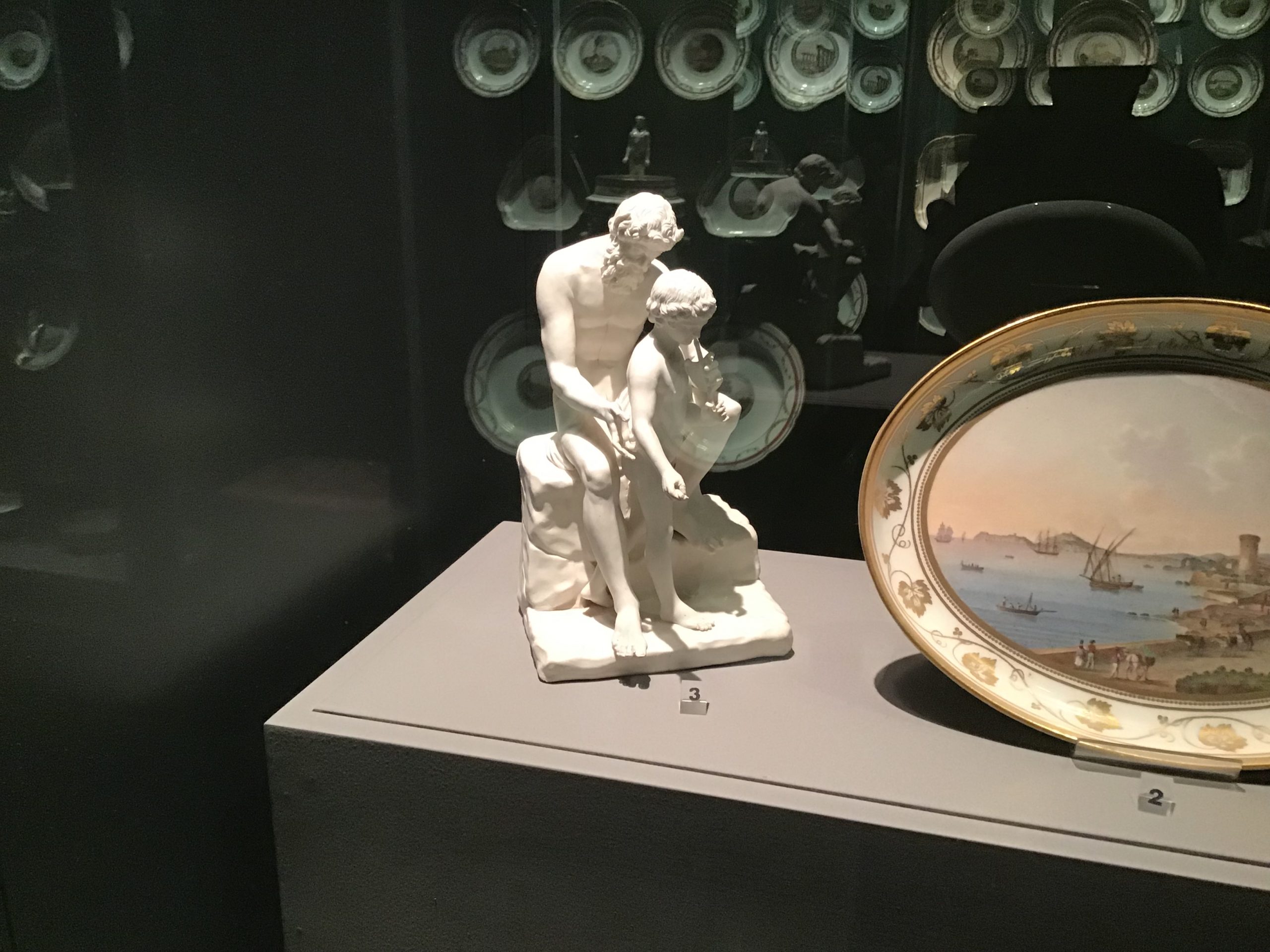
Marsias en Olympus
When a genealogy was applied to him, Marsyas was the son of Olympus[5], or of Oeagrus[6], or of Hyagnis.[7] Olympus was, alternatively, said to be Marsyas’ son or pupil.
Marsyas was an expert player on the double-piped double reed instrument known as the aulos.[8] The dithyrambic poet Melanippides of Melos (c. 480-430 BC) embellished the story in his dithyramb Marsyas,[9] claiming that the goddess Athena, who was already said to have invented the aulos, once looked in the mirror while she was playing it and saw how blowing into it puffed up her cheeks and made her look silly, so she threw the aulos away and cursed it so that whoever picked it up would meet an awful death.[9] Marsyas picked up the aulos and was later killed by Apollo for his hubris.[9] The fifth-century BC poet Telestes doubted that virginal Athena could have been motivated by such vanity.[10] Some account informs about the curse placed on the bearer of the flute, i.e; Athena placed a curse that the one picking up the flute would be severely punished.[11]
Later, however, Melanippides’s story became accepted as canonical[9] and the Athenian sculptor Myron created a group of bronze sculptures based on it, which was installed before the western front of the Parthenon in around 440 BC.[9] In the second century AD, the travel writer Pausanias saw this set of sculptures and described it as “a statue of Athena striking Marsyas the Silenos for taking up the flutes [aulos] that the goddess wished to be cast away for good.” (Wikipedia)