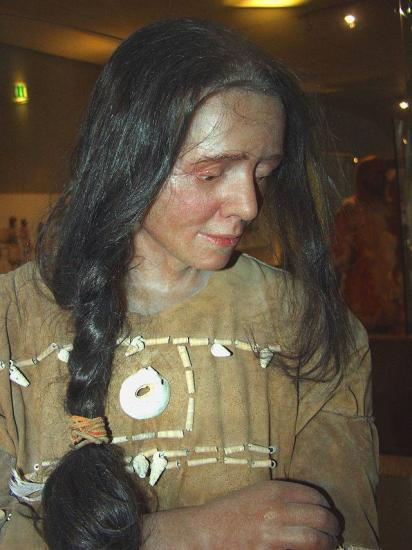
“The images painted and drawn on the walls [at Peche Merle, France] and at other Upper Palaeolithic sites in Europe show clear evidence of conceptual, abstract thought – the earliest such evidence in the world. The extraordinarily detailed artwork at Chauvet cave has been dated to around 32,000 years ago, the oldest in France. Recently discovered drawings at Fumane cave, near Verona in northern Italy, may date from as early as 35,000 years ago, which would make them them the oldest examples of cave art anywhere in the world. … The inhabitants of these European caves were clearly talented artists, and their culture marks a distinct departure from that of the Neanderthals that preceded them. It marks the beginning of the Upper Palaeolithic in Europe, and broadcasts the arrival of fully modern humans on the scene. … We saw earlier that the most obvious location from which to enter Europe, the Middle East, appears to have contributed little to the gene pool of Europeans. The Y-chromosome lineage defined solely by [the M89 marker], which would have characterized the earliest Middle Eastern populations around 45,000 years ago, is simply not very common in western Europe. It is such a tiny hop across the Bosporus from the Middle East to Europe that we might ask why it took so long – perhaps 10,000 years – for modern humans to make a significant foray into western Europe. … [The M173 marker] is found at high frequency throughout western Europe. Intriguingly, the highest frequencies are found in the far west, in Spain and Ireland, where M173 is present in over 90 per cent of men. It is, then, the dominant marker in western Europe, since most men belong to the lineage that it defines. … the most likely date for the origin of M173 is around 30,000 years ago. This date means that the man who gave rise to the vast majority of western Europeans lived around 30,000 years ago – consistent with a recent African diaspora, and again showing that Neanderthals could not have been direct ancestors of modern Europeans. Significantly, it is around this time that the Upper Palaeolithic becomes firmly established in Europe – and the Neanderthals disappear. … By 25,000 years ago they had disappeared entirely. [How and why this happened is still not definitely established. It is very unlikely however, that the Cro Magnons exterminated the Neanderthals physically. There is simply, as of now, no archelogical proof for that.] … Whatever the causes of their demise, Neanderthals had given up the ghost within a few thousand years of the arrival of modern humans. After 30,000 years, the only remains found in Europe are those of fully modern humans – often called Cro-Magnons … These early Europeans were much more gracile, and significantly taller, than their Neanderthal neighbours [often 180 cm, to Neanderthals arond 165 cm], … with long limbs.” (Spencer Wells, The Journey of Man, Princeton/Oxford 2002, p. 126 et seq.)