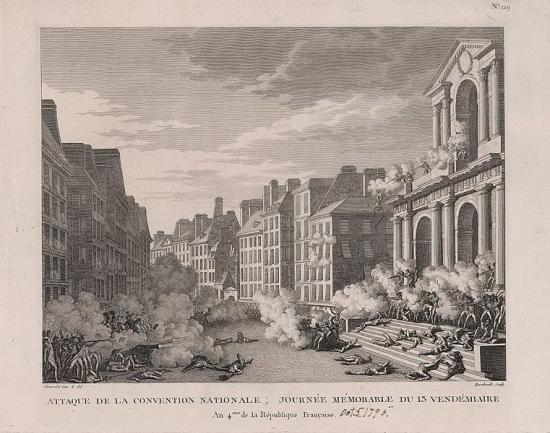
“On … 3 October 1795, led by the royalist Le Peletier, seven Parisian sections declared themselves to be in rebellion. General Menou, commander of the Paris garrison, made it plain that he sympathised with the rebels. … The men of Thermidor were in a panic and looked to Barras to save them. … [Barras] then sent word to Napoleon who heeded the call … Napoleon and Barras placed four thousand men in a protective cordon around the Tuileries … Finally, at about 4.45 on the afternoon of 5 October, the attack on the Tuileries began. The onrushing rebels ran into murderous artillery fire of a kind never yet experienced in the revolutionary battles. Taking heavy losses, the attackers pulled back into the rue St-Roch and regrouped at the church of that name … [Napoleon] personally commanded the battery of two 8-pounders loaded with case-shot, facing the church. He called up more cannon and then unleashed a deadly fusillade, mowing down the insurgents in droves. This was the action he later euphemistically called ’the whiff of grapeshot’ … That night the rain pelted down again, washing away the gore of an urban battlefield. There were four hundred corpses inside St-Roch church and another thousand bodies lay dead on the streets … Barras informed the government that Napoleon was the hero of the hour and must be promoted to major-general … A week later Barras resigned his post as Commander-in-Chief of the Army of the Interior and recommended Napoleon as his successor.” (Frank McLynn, Napoleon [London 1998], p. 93 et seq.)