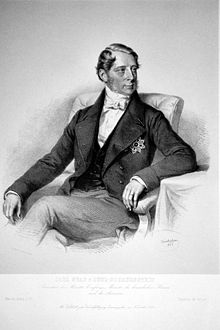
Count Karl Ferdinand von Buol, Austrian Minister of Foreign Affairs 1852-1859:
In Febr. 1853 Tsar Nicholas I demanded a Russian protectorate over all 12 million
Orthodox Christians in the Ottoman Empire, with control of the Orthodox Church’s hierarchy. The Sultan accepted some, but rejected the more sweeping demands. Russia reacted with an invasion across the Pruth River into the Ottoman-controlled Danubian Principalities of Moldavia and Wallachia.
” … the immediate problem to be solved was the Russian military presence in the principalities. Nicholas had ordered the move to put pressure on Turkey to agree to the terms dictated by Menshikov, but the invasion had also disrupted the regional strategic balance. The Austrians were displeased by the deployment because any conflict in the area would disrupt trade along the Danube, the main conduit into Europe. In theory Austria was Russia’s ally and Nicholas took Vienna’s support for granted, but the Austrians were now suspicious of Russian territorial intentions in the Balkans. Even so, they were in a difficult position. If they threw in their lot with Britain and France their proximity to Russia would force their army to bear the brunt of the fighting. Yet, full-blooded support for Nicholas would only make them more dependent on Russia. There was also the question of national pride. Four years earlier the Austrians had been forced to ask for Russian help in quelling an uprising by Magyar nationalists and there was a lingering sense of shame and resentment. Nicholas had forgotten the old dictum that personal indebtedness can often spoil the closest of friendships. And so it proved. When Britain and France put pressure on the Austrians to involve themselves in the crisis they were happy to make hasty arrangements for a governmental meeting in Vienna. Convened by … Count Buol-Schauenstein … the meeting had the twin aims of ending the Russian occupation of the principalities and of settling the dispute over the protection of the Orthodox Christian communities within the Ottoman Empire.” (T. Royle, Crimea. The Great Crimean War 1854-1856, p. 65 et seq.)