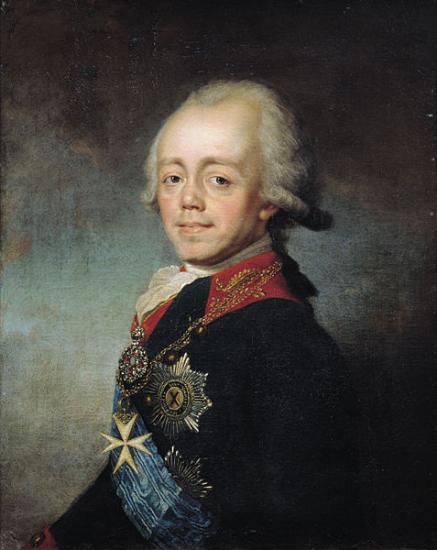
Paul I of Russia, murdered on 24 March 1801: “Sometime in June [1800] [general Peter von der] Pahlen had arranged what was to become a series of secret meetings between Panin and [grand duke] Alexander [Paul’s eldest son and heir tsar Alexander I 1801-1825]. Panin took to the conspiratorial role with enthusiasm … The grand duke, on the other hand, was nervous and had trouble concentrating on what he was told, so fearful was he of discovery and exposure. What Panin argued was essentially that Paul should not be permitted to continue ruling, that his judgement was wholly unreliable, and that he was committing atrocities against his loyal servitors. He had become a threat to Russia’s stablility and Europe’s peace. … While [the grand duke] did not, at least initially, approve of what was presented to him, he did not reject it, nor did he betray Panin to Paul. … [By November] of the original ‘conspiracy’ only Pahlen and the grand duke Alexander remained. But Pahlen, whether because of what Paul was doing in his foreign policy, his turn to increasingly cruel punishments for his subordinates, the threat his own ambitions faced from Paul’s unpredictable irascibility, or for a combination of these motives, actively took up organizing a coup. His argument to Alexander was that it had become imperative to remove Paul, while the grand duke, faced with multiplying evidence of his father’s animosity and malign intent towards himself, his mother, and his brother, began to agree, though he was always to claim that he insisted that his father should not be harmed. … [Pahlen however] provided virtually nothing in the way of safeguards for protecting the tsar when the conspirators seized him, while the sort of people he recruited and gave the task of capturing the tsar made it unlikely that Paul would escape with his life. What Pahlen needed from Álexander was his acquiescence in the coup attempt. Once it had happened the grand duke would be implicated and an ally, willing or unwilling, of the succesful conspirators. This Pahlen was to accomplish. What he did not foresee was Alexander’s profoundly guilty reaction which made him susceptible to his mother’s fixed determination to avenge her husband.” (R.E. McGrew, Paul I of Russia 1754-1801 [Oxford 1992], p. 333 et seq.) ” … in clinical terms there are no certain or even substantial grounds for considering Paul insane. But then the men who called him mad were not speaking clinically. What they expressed was their repugnance for behaviour that seemed to have no grounding in reason, that was extreme, contradictory, highly charged emotionally, and at odds with what they saw as normal. … Though Paul was probably not certifiable, there is substantial evidence that he behaved irrationally and unpredictably, that he had a vicious temper, that he was capricious, headstrong, suspicious to an extraordinary degree, fearful, dependent, vengeful, and perverse. Though subject to persuasion by people he claimed to trust, he recognized no limits on what he was empowered to do, while the quality of his decisions, and even the attention he was willing to give to the jobs at hand, fluctuated greatly.” (idem, p. 337)