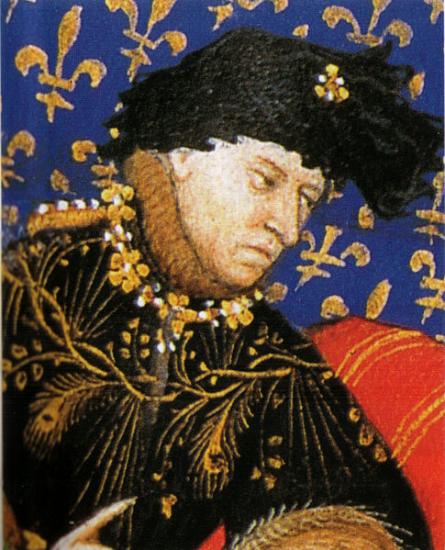
Charles VI, king of France (1380-1422)
“The king’s first psychotic episode, which took place in 1392, was preceded by a serious illness. … It is thought that he was suffering from typhoid fever. … on the night of June 13, Pierre de Craon, recently stripped of his posts as chamberlain of the king and the king’s brother Louis of Orléans, attempted with several accomplices to murder the constable of France, Olivier de Clisson … The constable sustained several wounds but survived, and Pierre took refuge at the court of the duke of Brittany. The king saw this crime as an attack on his own majesty … Because of his anger with the duke for harboring the criminal, King Charles resolved to lead an army into Brittany. … The Monk of Saint-Denis, in his capacity as official historian of his abbey, accompanied the army to make an eye-witness report, and he noticed that during the first days of August, in Le Mans, the king began to utter “silly” words and make gestures “unbecoming to royalty”, as if he were not of sound mind. … On August 5, Charles VI, in full armor, led the army out of Le Mans, and when the reached the leper colony outside the town, a bedraggled and beggarly man began to trail alongside him. For a half hour this person continued to shout, “Go no further, great king, for you are to be quickly betrayed!” Finally, when the man grabbed the reins of the king’s horse, several men-at-arms intervened and struck him on the hands. He ran off, and the army continued its march. When they came out of the forest onto a sandy plain, King Charles rode a little ahead with two young pages to escape the dust raised by soldiers and horses. One of the pages, drowsy from the mid-day heat, let the lance he was carrying fall against the helmet of the other page. Alarmed by the loud noise, the king suddenly drew his sword and shouted, “Advance! Advance on these traitors!” The pages spurred on their horses and managed to escape, and the king then turned to attack his brother, the duke of Orléans, who was riding closer to him than the other dukes. There followed a scene of great confusion in which Charles VI killed five men, among whom was the bastard of Polignac, a Gascon knight. When the king’s sword finally broke under the force of the blows he struck, Guillaume Martel, one of his favorite chamberlains, succeeded in grabbing him from behind. King Charles was taken down off his horse and laid on the ground. When his uncles and brothers approached, he gave no sign of recognition. His eyes rolled in his head, and he spoke to no one. He was taken back to Le Mans in a litter, and the Monk says that he remained for two days without the use of his senses or limbs. … On the third day the king began to speak, and he humbly begged pardon for what he had done. He went to confession, heard mass, and took Holy Communion.” (R.C. Famiglietti, Royal Intrigue. Crisis at the Court of Charles VI 1392-1420. [New York 1986], p. 1-3)