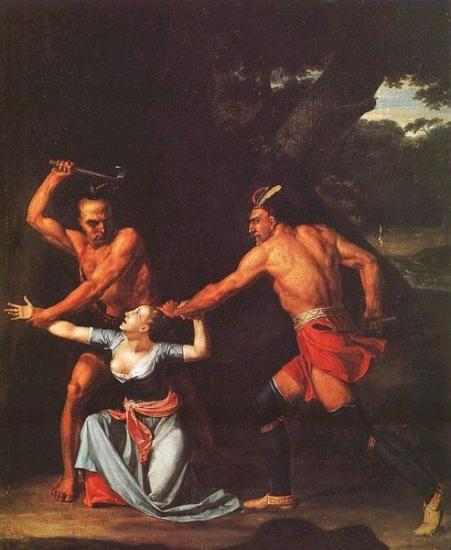
John Vanderlyn, The death of Jane MacCrea (1804)
“[In 1777] anti-British feeling in America was certainly much fostered by the behaviour of the Indians whom [British commander John] Burgoyne had enlisted in his army. Contemporary accounts are full of alleged Indian atrocities. … Appalled by the conduct of the Indians in Ticonderoga, where they had stayed behind to drink and plunder, and by the sight of scalps hanging up to dry in the sun around their camps, Burgoyne had repeated his warnings and orders to their chiefs … The Indians did not obey Burgoyne’s rules even in so far as they understood them. … News of one particularly horrifying depredation spread fast throughout the colonies. The victim was a young, good-looking woman, Jane McCrea, a Presbyterian minister’s daughter, who was engaged to a loyalist lieutenant in Burgoyne’s army. With another woman of loyalist sympathies … Jane McCrea was apparently abducted by Indians from a house near Fort Edward. The two women were carried into a wood where, according to an American soldier who had also been captured by Indians and claimed to have witnessed the scene, ‘violent language passed between the Indians, & they got into high quarrel, beating each other with their muskets. In the midst of the fray, one of the Chiefs in a rage shot Jenny McCrae in her breast, & she fell & expired immediately. Her hair was long and flowing and the same chief took off the scalp, cutting so as to unbrace nearly the whole of that part of the head on which the hair grew. He then sprang up, tossed the scalp in the face of the young Indian standing by, brandished it in the air, and uttered a savage yell of exultation. When this was done the quarrel ceased & the whole party moved off quickly.’ … [Washington’s Adjutant General] Horatio Gates wrote a letter of vehement protest to Burgoyne. … In a characteristically grandiloquent reply, Burgoyne indignantly denied the charge that he had paid the Indians for scalps, though he admitted paying them for prisoners because this ‘would prevent cruelty’. … having had the murderer brought before him, he had decided that a pardon ‘would be more efficacious than an execution to prevent similar mischiefs’. Had he had the man executed, the Indians would have immediately deserted and created havoc in all the settlements they passed through on their way home. Protest as he would, however, the behaviour of the Indians did much to damage the reputation of the British, and the image of an Iroquois chief in their service carrying the scalp of a young American woman … was a valuable gift to revolutionary propaganda.” (Ch. Hibbert, Redcoats and Rebels [New York 2002], p. 172-174)