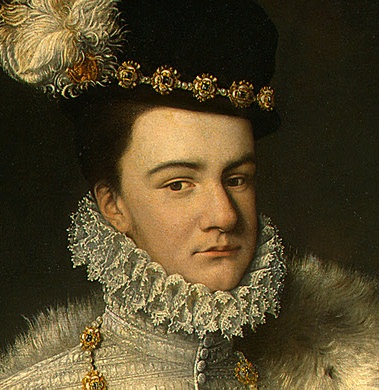
Hercule François hertog van Anjou en Alençon(1555-1584)
“The Duke of Anjou arrived at Greenwich early in the morning of 17 August [1579]… At sunset, Anjou dined with the Queen [Elizabeth I], who had stolen out of the palace with one of her ladies. Until their meeting, she had expected him to be a hideously disfigured, misshapen dwarf; instead, there now stood before her a mature and attractive man, whose pitted skin did not detract from his dark hair and eyes and witty galantry, and it occurred to her that here was a very desirable husband indeed. ‘I have never in my life seen a creature more agreable to me,’she declared. … She nicknamed him her ‘Frog’ and they exchanged gifts, made extravagant promises, and swore to love each other until death parted them. … Yet opposition to the match was now stiffer than ever in England, especially in the capital, and even some courtiers were violently opposed to it. Philip Sidney, remembering the horrors of St. Bartholomew’s Eve, wrote Elizabeth an open but courteous letter of protest, reminding her how perfidious were the French Catholics and insisting that Anjou, whose mother [Catharina de Medici] was a ‘Jezebel of our age’, would be wholly unacceptable to her Prostestant subjects, ‘your chief, if not your sole, stenght’. … [In October she asked her Council for advice.] This gave rise to heated discussions. With Walsingham absent, Leicester and Hatton mustered five other councillors who were against the marriage, while Burghley led four others in favour. … When , on 7 October, a deputation of four councillors wanted on her to know ’the inclination of her mind’, she burst into tears at the realisation that she would have to turn down her last chance of marriage and motherhood. … Elizabeth knew now that, if she wished to retain the love of her subjects, she could never accept Anjou as a husband, although it was important that the marriage negotiations be prolonged in order to keep the French friendly and the Duke under control.” (A. Weir, Elizabeth the Queen,(Londen 1998), p. 324-329]