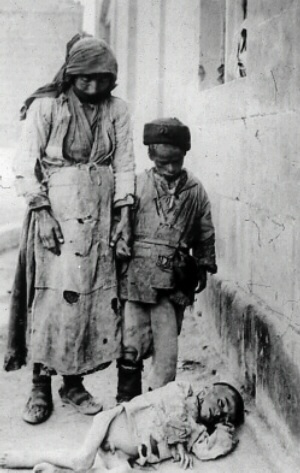
Guenter Lewy, The Armenian Massacres in Ottoman Turkey (The University of Utah Press, Salt Lake City 2005), p. 256-257: “We do not know how many Armenians perished [in 1915-1916] as a result of starvation and disease and how many were killed by Kurds, seeking booty and women, or by fanatic Muslims, who regarded the Armenians as infidels and traitors. For all these occurences the incompetent Ottoman regime bears some indirect responsibility. But there is a difference between ineptness, even ineptness that has tragic and far-reaching consequences, and the premeditated murder of a people. … [The Young Turk] government [in power since 1908] also badly mishandled its wounded souldiers, refugees, and prisoners of war, but one would hesitate to consider these acts of neglect and callousness a crime of equal magnitude as deliberate killing. Even the fact that some fanatic Young Turk officials welcomed the death of large numbers of Armenians is not the same as intentionally seeking and causing such deaths. It is impossible to ignore the horrors to which the Armenians were subjected, but it is important to see these terrible events in their proper historical context. The order for the deportation of the Armenian community was issued at a time of great insecurity, not to say panic, which made any calm calculation of possible consequences difficult and unlikely. Any full discussion of the events of 1915-16 also cannot ignore the impact of the loss of Van [on May 17 1915 Russian-Armenian units, followed a little later by Russian troops, entered the city of Van in Eastern Turkey (near the Russian border)] and the displacement of large numbers of Muslims in eastern Anatolia, who were forced to flee for their lives in the face of the advancing Russian armies and their Armenian helpers. This dislocation increased hostility toward the Armenians among the Muslim population of the empire and added to the tensions created by charges of Armenian treason. The fear that the Armenian population constituted a fifth column may have been exaggerated, but it did have some basis in fact. While the Armenians were victims, not all of them were innocent victims; and the disaster that overtook them therefore was not entirely unprovoked. Most importantly, while the Ottoman government bears responsibility for the deportations that got badly out of hand, the blame for the massacres that took place must be put primarily on those who did the actual killing. [Practically all of the known massacres were carried out in eastern and central areas of Anatolia inhabited by Kurds or in places of resettlement populated by Circassians … There were no massacres in Cilicia or in Syria south of Aleppo or in Palestine. Most of the references to the killers by contemporary witnesses involve Kurds, Circassians, brigands, irregulars, and the gendarmes accompanying the convoys. Gendarmes are also implicated in the murders of Armenians arrested before the beginning of the deportations.” (idem, p. 221)]
Lewy neemt aan dat het totale aantal Armeniërs in het Ottomaanse Rijk vóór het uitbreken van de Eerste Wereldoorlog ongeveer 1.750.000 personen bedroeg. Het aantal overlevenden (kort na het einde van de oorlog) raamt hij op 1.108.000. Dit houdt in dat ongeveer 642.000 Armeniërs zijn omgekomen, ofwel 37 % van de in 1914 onder Turkse heerschappij levende Armeense bevolking. [Lewy, o.c., p. 234-241] Van die overlevenden emigreerden er ca. 200.000 naar de Franse en Britse mandaatgebieden in het Midden Oosten, bijna 100.000 naar de V.S. en meer dan 30.000 naar Frankrijk. [Idem, p. 239]