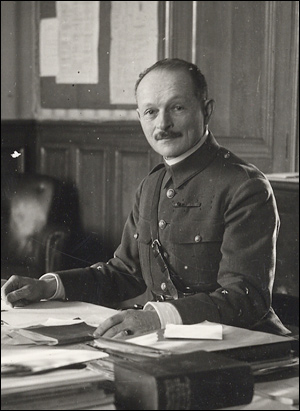
Generaal Maxime Weygand.
“[After the fall of Wilno on 12 July 1920, a] new [Polish] Government of National Defence was formed under the Peasant leader Wincenty Witos … The new government also issued an appeal for help to the Entente. Neither Britain nor France wished to get involved, but they felt they had to do something, so they took two steps, neither of which was to have any influence on the course of events. The first was a telegram to Moscow despatched by the British Foreign Secretary Lord Curzon, suggesting a ceasefire along a ‘minimum Polish frontier’sketched by himself and a peace conference in London [the Curzon Line]. The Russian response was predictable. Chicherin questioned the right of Entente, which was still waging war on Soviet Russia through the agency of the Whites, to mediate a peace. … At the same time, the Franco-British response demonstrated that the Entente was unwilling to come to Poland’s aid directly. Lenin calculated that it was therefore safe to continue the offensive, while agreeing to direct talks with Poland. … The other measure taken by the Entente was to send an Inter-Allied Mission to Warsaw … Much of their energy was directed at trying to place [French general Maxime] Weygand in command of the Polish army.” (Zamoyski, Warsaw 1920, Lenin’s failed conquest of Europe [2008] p. 57-58)