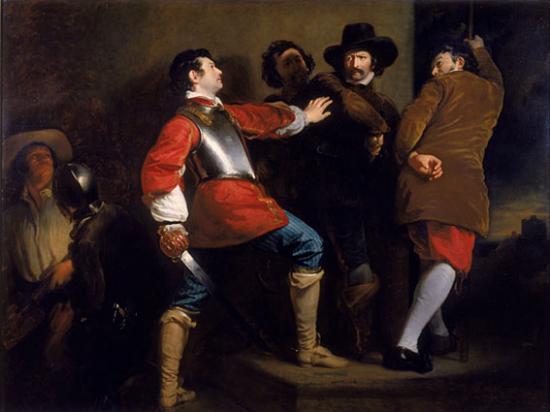
Discovery of the Gunpowder Plot [1605] by Henry Perronet Briggs, ca. 1823 “Lord Suffolk made the first search on Monday [5 November 1605. It did not reveal more than the fact that there was] an enormous amount of firewood – pile of faggots – heaped up in the cellar. Yet the lodging it served was quite small … That was one surprise. The second came when the [search] party was told … [that the current tennant of the house to which the storeroom belonged] was none other than Thomas Percy, kinsman and employee of the Earl of Northumberland. … The news also provoked from Monteagle a histrionic flash of revelation. Surely Percy must be the author of the anonymous letter? [warning him not attend the next Parliament on the 5 November]… There was not only’s Percy’s … Catholicism, which pointed to him, but there was also that ‘old dearness of friendship’ which Percy felt for Monteagle, to explain the warning. … But, for the members of the Privy Council not in the know, the name of Percy was somewhat of an embarrassment. … Percy’s connection to Northumberland, ‘one of his Majesty’s greatest subjects and councillors’, was well known. They would be ‘loath and dainty [reluctant]’ to interfere unnecessarily in such a way as to cast aspersions on such an august figure. The King was not content with this dainty approach. When he heard what had taken place, he pointed out sensibly enough that either a proper search must be made, or he would ‘plainly … go next day to Parliament’ and leave the outcome of the day ’to fortune’. … Thus a seach party, headed by [Sir Thomas] Knevett [a member of the King’s Privy Chamber and a Justice of the Peace for Westminster, went back to the Westminster cellar [were the gunpowder was stored]. It was there, around midnight on Monday 4 November or perhaps in the small hours of November, that a figure in a cloak and dark hat, booted and spurred as though for flight, was discovered skulking beneath the precincts of Parliament. This ‘very tall and desperate fellow’ was immediately apprehended and bound fast. He gave his name John Johnson, servant to Thomas Percy. It was a story that Guido [Guy] Fawkes would maintain steadfastly for the next forty-eight hours … On [7 November] … the gunpowder ‘from the vault of the Parliament House'[the vault was not a cellar but a storeroom on ground floor below the House of Lords]was transported to the Tower of London. … eighteen hundredweight of powder was received. Interestingly enough, the powder was described officially as ‘decayed’. … This powder … would not have exploded anyway.” (Antonia Fraser, The Gunpowder Plot [London 1996], p. 168-169, 187-188)”The prince of darkness at the centre of the Gunpowder Plot was Robert Catesby, not Guy Fawkes. A historical accident of discovery led … to Guido carrying the popular odium for the conspiracy down the ages. But Guido, although heavily involved in the action, was not at the heart of the strategy. He was the outsider in the band. With the single exception of Fawkes, the plotters formed a tight-knit circle of interlocking relationships which was a vital protective element in their dangerous and secret game. And it was Catesby who was ’the first inventor and the chiefest furtherer’of that game.” (idem, p. 90) Robert Catesby was killed by members of a posse comitatus (vigilante force), led by the High Sheriff of Worcestershire, Sir Richard Walsh, at Holbeach house, near Kingswinford, just inside Staffordshire, on Friday 8 November 1605. (idem p. 187)
“In April 1606 Henri IV of France decided to give King James a little lecture on the virtues of toleration … Let King James … punish the guilty, but let him equally spare the innocent … The King told the French Ambassador that the English Catholics ‘were so infected with the doctrine of the Jesuits, respecting the subordination of the royal to the papal authority’, that he could do nothing. He would leave it to his Parliament. So another Oath of Allegiance was devised, with help from an Appellant Catholic priest, intended to increase the rift between those priests prepared to ‘compromise’ with the state, such as the Appellants, and those who could not, the Jesuits. It was an oath which resulted in a long propaganda war between King James and the defenders of the Pope’s spiritual supremacy. But from the point of view of the hapless recusants, such doctrinal wars were less important than the disablities which came to burden their daily lives. As thes disabilities multiplied, Catholics could no longer practise law, nor serve in the Army or Navy as officers (on pain of a hundred pounds fine). No recusant could act as an executor of a will or guardian to a minor, nor even possess a weapon except in cases of self-defence. Catholics could not receive a university degree, and could not vote in local elections (until 1797) nor in Parliamentary elections until Catholic Emancipation in 1829. All this was on top of the spiritual penalties by which Catholics were ordered to marry in the Anglican church, take their children there for baptism, and finally rest in its burial ground.” (idem, p. 282-283)