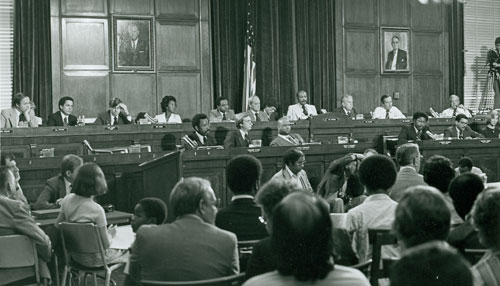
James B. Wilcott was a CIA accountant who disbursed CIA station funds in Tokyo, Japan. His duties routinely brought him in contact with all station people, and in particular with operational agents. On many occasions he had conversations with CIA personnel concerning Lee Harvey Oswald’s employment as a CIA agent. Wilcott swore in a secret session of the House Select Committee on Assassinations [MARCH 22, 1978] that money he himself had disbursed was for “Oswald” or for the “Oswald project.” He knew several other CIA employees who knew about the “Oswald project” and knew that Lee Harvey Oswald was paid by the CIA.
Wilcott was told on several occasions that “so and so” (names not mentioned) had worked on the “Oswald project” back in the late 1950s. Wilcott told the HSCA that Oswald was recruited by the CIA for the express purpose of a double agent assignment in the USSR. Following the assassination Wilcott said there was “very heavy talk” from November 22 through January, 1964 about Oswald’s connection to the CIA. He also told a Garrison investigator that it was from these conversations that he learned that the “project” (assassination of JFK) may have been under the direction of Allen Dulles and Richard Bissell. It was done, he said, in retaliation for Kennedy reneging on a secret agreement with Dulles to support the invasion of Cuba. Elaborate preparations had been made to firmly put the blame on Castro, and an immediate attack on Cuba would follow the assassination. After Oswald (HARVEY) was killed by Jack Ruby, Wilcott discussed this with a close circle of friends. They had no doubt that Oswald had been a “patsy” and that former gun-runner and “cut-out” Jack Ruby was instructed by the CIA to kill Oswald. After 9 years of employment with the CIA, Wilcott resigned in April, 1966.
The document excerpted below was acquired by John Armstrong after his JFK Lancer presentation in Dallas in 1997. Selected pages from the National Archives are presented graphically; the remainder, to preserve bandwidth, are excerpted typographically.
“Mr. Cornwell. In the conversations which you have
described occurring within a period of one, two or three
months after the assassination with other CIA employees and
officers, did they suggest in those conversations to you that
their employment, the CIA’s employment, of Oswald had any
relation to the assassination or only that it related to the
events you have already described — namely, the training of
him in Atsugi in the Russian language and the sending of him
to Russia and using of him as a double agent and that sort of
thing?
Mr. Wilcott. I am sorry, sir; I lost the thread of your
question.
Mr. Cornwell. In the conversations you had with other
CIA employees, the six or seven persons who purported to have
good information about the use of Oswald as an agent, did any
of those people say anything to you which suggested that the
CIA had some role in the assassination of President Kennedy?
Mr. Wilcott. Yes, sir.
Mr. Cornwell. What did they say along those lines?
Mr. Wilcott. Along those lines they said things like,
well, that Oswald couldn’t have pulled the trigger, that only
CIA could have set up such an elaborate project and there was
nobody with the kind of knowledge or information that could
have done this, and this was more in the speculative realm.
As far as that they actually said, they said they were
having trouble with Oswald and that there was dissatisfaction
with Oswald after he caine back from the Soviet Union, and the
would say things like “Well, you know this was the way to get
rid of him — to get him involved in this assassination thing
and put the blame on Cuba as a pretext for another invasion
or another attack against Cuba.”
That was the kind of things that people said. How much
exact knowledge they had it is impossible for me to say. I
believe it was more in a speculative realm.
(http://harveyandlee.net/Wilcott/Wilcott.htm)