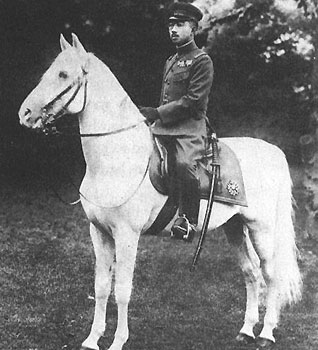
“The Showa emperor [Hirohito,regent 1921-1926, emperor of Japan 1926-1989]shared in the collective responsibility for the war, and not merely in a formal legal sense. He individually did not and could not approve starting a war with China, the United States, or anyone else, but he was actively involved in the decision to go to war reached in the fall of 1941, as well as in many other political and military decisions before the attack on Pearl Harbour. He participated in these decisions because he was the head of state, and head of the imperial line, but his powers, while noted in the [1889 Meiji] constitution, were not based on that document. The emperor’s legitimacy in the prewar era was based on three pillars: his descent from the Sun Goddess; his possession of the imperial regalia (sword, jewel, and mirror); and the performance of ceremonies honoring the Sun Goddess. … The imperial house as an institution was essential to the continued existence of native Japanese religion, the Japanese folk, and state, For this reason the preservation of the imperial house was of great importance to Hirohito personally, his immediate advisers, and also many lesser persons. …”(P. Wetzler, Hirohito and war [Univ. of Hawai’i, 1998], p. 3-)