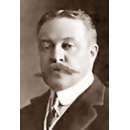
Alexander Isvolski. “[Nicholas II] wrote to his mother on 18 March [1909] that ‘last week … I held a Council of Ministers in connection with that wretched Austro-Serbian question [the Bosnia crisis of 1908-1909]. This affair, which had been going on for six months, has suddenly been complicated by Germany telling us we could help to solve the difficulty by agreeing to the famous annexation while, if we refused, the consequences might be very serious and hard to foretell. Once the matter had been put as definitely and unequivocally as that, there was nothing for it but to swallow one’s pride, give in and agree. The Ministers were unanimous about it. If this concession on our part can save Serbia from being crushed by Austria, it is, I firmly believe, well worth it. Our decision was the more inevitable as we were informed from all sides that Germany was absolutely ready to mobilise … But our public does not realise this and it is hard to make them understand how ominous things looked a few days ago, now they will go on abusing and reviling poor Isvolsky [Russia’s minister of foreign affairs] even more than before.’ The next day Nicholas wrote a postscript to his letter: ‘Nobody except the bad people want war now, and I think we have been very close to it this time. As soon as the danger is over people immediately begin shouting about humiliation, insults etc. For the word ‘annexation’ our patriots were prepared to sacrifice Serbia, whom we could not help at all in the case of an Austrian attack. It is quite true that the form and method of Germany’s action – I mean towards us – has simply been brutal and we won’t forget it. I think they were again trying to separate us from France and England – but once again they have undoubtedly failed. Such methods tend to bring about the opposite result. ” (D. Lieven, Nicholas II. Emperor of All the Russias [Londen 1993], p. 193-194)