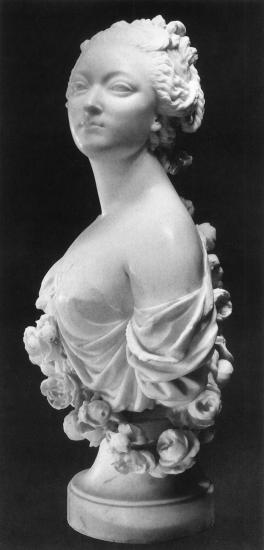
J.J. Caffieri, Madame du Barry, maitresse van koning Lodewijk XV van Frankrijk. [In May 1774 King Louis was dying of smallpox at the chateau in Versailles] “no sooner had he settled in bed and had got rid of what appeared to be the entire faculty of medicine, which now filled an already crowded room, than he asked for Madame du Barry, and neither his doctors nor his daughters dared to refuse him. Blamed for what the King’s courtiers described as her neglect, and ignored by Mesdames [his unmarried daughters], Madame du Barry was quietly crying in her apartment when she was called upon to act the role of heroine. While his daughters continued to nurse their father by day, Madame du Barry took their place by night. … It must have been terrifying for a woman whose very existence depended upon her beauty to expose herself to an illness which could destroy her lovely face. … Taking her place by the camp bed to which for comfort and convenience they had brought the King, she would sit in silence, stroking his hot and feverish forehead and at times, in a last flicker of lust, he would stretch out a wasted arm to pull at her bodice and fumble with her breasts. … [He lingered on until 10 May,] his body putrefying, his mind calm and lucid to the end. Those who were praying in the council chamber saw him across a vista of rooms, lying on his camp bed, his face covered in pustules, swollen and “dark as if he were a Moor”. … To save his immortal soul the cardinal [de la Roche Aymon, who took his confession, which he had not made in over 30 years] had forced the dying King to dictate the lettre de cachet which sent the Comtesse du Barry as a prisoner of state to the abbey of Pont aux Dames.” (J. Haslip. Madame du Barry [London 2005], p. 100-103)