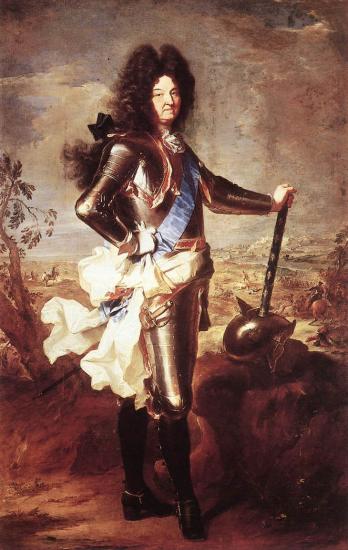
Louis XIV, king of France and Navarre (1643-1715): “when it came to decision-making, only too often his ministers knew what the king wanted, and in order to preserve their own positions went along with him. This scenario applied to religious issues such as the prosecution of Protestants and Jansenists. But it is most apparent in the conduct of foreign policy – which too often meant war. As a result, the suffering caused on the battlefield and by the king’s marauding troops was equalled by the impoverishment of the French population, which had to finance Louis’ wars. … This is not to argue that Louis’ warmaking was devoid of positive results. He left France less vulnerable to invasion. Parts of the French economy were stimulated – iron foundries made guns, clothiers made uniforms, timberyards made warships. War may have stimulated patriotism, or at least a growing awareness of national identity. … Louis XIV undoubtedly made problems for his successors by repressing opposition, without enabling criticism and suggestions for improvements and reforms to be expressed. He created a huge army, but failed to match its growth with financial measures that would make it affordable, so a massive debt encumbered his successors. Furthermore the religious, social and economic problems Louis exacerbated continued to create friction. Although he disarmed the aristocrats who had exploited the Fronde, the greater nobles, far from being crushed by the Versailles system, were brought into the heart of political life and developed a sophisticated technique for influencing the monarchy, often with unfortunate results. The explosion of frustration and rage that eventually swept away the ancien régime was therefore partly the Sun King’s fault.” (R. Wilkinson, Louis XIV [London 2007], p. 227 et seq.)