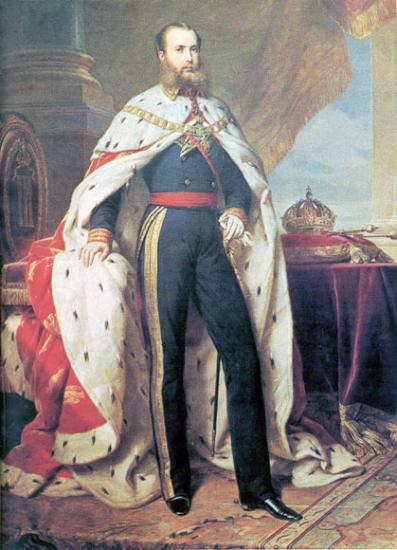
Winterhalter, Maximiliaan van Oostenrijk (1832-1867), keizer van Mexico.
“Despite accusations of pressuring Maximilian and wanting only to serve his own interests, Napoleon [III] has been shown to have been the most cautious of all the interested parties about imposing a monarchy [on Mexico], and the most anxious to ensure that it was the will of the people. He did not exert any pressure on Maximilian until after he had concluded lenghty negotiations, during which Maximilian had obtained from the Emperor all that he wanted, especially in relation to payment of the indemnity of Mexico to France, the number of French troops to remain in Mexico, and other concessions … With Maximilian’s departure for Mexico, and Bazaine’s reports of continued French military successes, Napoleon might reasonably have expected that Mexico would soon be less demanding of French resources. He wrote to Bazaine in August 1864, two months after Maximilian’s arrival, emphasising the need to develop the indigenous army so the French could leave as soon as possible. The early news from Mexico also indicated that the prosperity of the country, at least in those areas controlled by the French, was improving … In November 1864, Napoleon wrote to Maximilian impressing the need for his government to establish its credit in the light of bonds issued in Paris for a new loan, which would provide a considerable sum for him by early 1865. He added that it was necessary for Maximilian to establish a sound bank in Mexico, as leading bankers in Paris and London had agreed to ‘place themselves at the head of this establishment’. His advice about developing the resources of Sonora and other areas of Mexico, however, was incomprehensibly rejected by Maximilian. A few days after Napoleon wrote to Maximilian, a report in The Times indicated that the Mexican people had already begun to be disillusioned by Maximilian’s apparent inactivity. They were concerned that he had left the capital to explore the country even before he had established a ministry, and without having issued any decrees. … [Napoleon’s] patience finally was overstretched by a report from Bazaine, at the end of October [1865], which showed that things were not going well. Napoleon told Bazaine that France could no longer remain in such a situation of uncertainty with its prolonged demands on their finances, and he had to make an ‘energetic resolution’. His impatience was obvious: … “The Emperor Maximilian must understand that we cannot remain indefinitely in Mexico, and that instead of building theatres and palaces, it is essential that he brings some order to the finances and to the main transport routes. He should know that it will be much easier to abandon a government which has done nothing to support itself than to support it in spite of itself.” Napoleon then optimistically advised his two Chambers in January 1866, that as Mexico was now governed by ‘a regular power which was ready to fulfil its commitments, and respect foreigners and their property in Mexico’, he would soon be able to advise the date by which the expeditionary force would be withdrawn – after necessary arrangements were concluded with Maximilian. … (M. Cunningham, Mexico and the Foreign Policy of Napoleon III [New York 2001], p. 181-185) “In a determined bid to get continued support from Napoleon, the Empress Charlotte [wife of Maximilian] came to Paris in August 1866. Napoleon however, could only tell her that they could do no more for Maximilian, except to help him leave. … Napoleon then decided to send one of his most trusted generals, General Castelnau, to Mexico to make a thorough assessment of the situation. Castelnau was instructed to encourage Maximilian to abdicate if he determined that the imperial government could not sustain itself after the departure of the French. … Shortly after his arrival Castelnau noted, from information gathered from Mexicans, that the financial measures Maximilian had undertaken were only expedients, more often than not ill-advised, and the most fundamental issue of the nationalised property of the clergy had been the subject of a series of regulations, each more impractical than the others. … While Castelnau concluded that the only solution was for Maximilian to abdicate, the Emperor proved to be just as indecisive about abdicating as he had been about all his actions in Mexico. In November Castelnau reported that Maximilian was ready to leave Mexico, but, in the ensuing weeks, many of his associates – including Bazaine, who had a Mexican wife and personal interests he wished to maintain in the country – tried to convince him that the Empire still had some chance of surviving.” (id. p. 189-190)