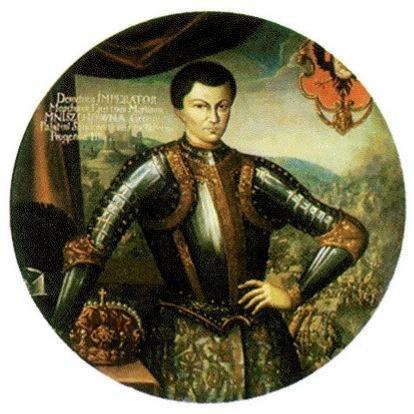
Valse Dimitri I, tsaar van Rusland 1605-1606. “In the summer of 1603 a young man, recently taken into the service of Prince Adam Vishnevetsky astonished his master by declaring thet he was Tsarevich Dimitri, the youngest son of Tsar Ivan IV [who reportedly had died in Uglich in 1591]. … Impressed by his bearing and eloquence, the prince was inclined to accept the story. He also saw political advantage in befriending the claimant to the Muscovite throne. His estates were … on the then Polish side of the Dniepr River … If this young Pretender became Tsar, he would be able to look to him for protection and greater rewards. Vishnevetsky sent a report to [the Polish] king on the sudden appearance of the Tsarevich Dmitri. Sigismund responded cautiously. He could not risk violating the twenty-year peace recently concluded with Tsar Boris. He gave orders nevertheless for the young man to be brought to Krakov. … [En route, in Sambor, Dmitri met his future wife, Marina Mnishek, daughter of steward of the king’s estate at Sambor.] In March 1604 he arrived in Krakov. The identity of the young man who claimed to be the son of Tsar Ivan has been debated endlessly. … All surviving evidence suggests that he was a Russian, chosen and put up to serve as Pretender to the throne. [Tsar]Boris had no doubt on this score. Hearing from the first time that the False Dmitri had appeared in Poland, he turned to the princes and boyars at court and said to their faces, “This is your doing!” From the investigations, carried out by Patriarch Iov [Job] and Semen Godunov, he was evidently satisfied that the Pretender was a certain monk by the name of Grigori or Grishka Otrepyev. … In Krakov the arrival of the Pretender had aroused special interest. The Roman Catholic Church saw in him a means of promoting its influence in Russia and in particular of pursuing the cherished policy of uniting the Eastern and Western Churches. Pope Clement VIII … was inclined to dismiss as an impostor [but] … agreed … to sponsor Dmitri’s efforts to seize the throne in Moscow. Dmitri himself recognised that he must embrace Roman Catholicism if he was to gain Polsih support for his claims. [Another reason was that he wanted to marry Marina, whose family were fervent Catholics. When told by the papal nuncio that king Sigismund would help him only if he joined the Church of Rome, the Pretender readily agreed. The following month, April 1604, he was received secretly into the RC church. Marina and agreed that he could married her, provided the weddeing took place after he had been crowned Tsar. Sigismund promised him an annual grant of 4,000 florins and] gave permission for all nobles who wished to do so to use their own troops and any other Polish volunteers in the Pretender’s campaign to secure the Russian throne. [In August 1604 Dmitri set out with 2000 Polish and Ukrainian volunteers. Near Kiev the ywere joined by some 2,000 Don Cossacks. Thousands joined him on the march. By the time he reached Chernigov he had a force of 10,000 men.” [He defeated the Tsar’s army at Novgorod-Seversky on 21 Dec.] Boris had mobilised a new army after the defeat at Novgorod-Seversky, and he entrusted it to the command of Prince Vasily Shuisky. … Shuisky’s army joined battle with Dmitri’s forces near Dobrynichi and on 21 January, 1605, completely routed them. … Shuisky had not followed up his victory by destroying the remainder of Dmitri’s force. … But even with Cossack support and with the disaffection within the Tsar’s army especially among its commanders, [Dmitry’s] campaign was foundering. It was saved because suddenly on 13 April, 1605, Boris died. … One of the first acts of the new Tsar [Fedor II] was to recall to Moscow Princes Fedor Mstislavsky and Vasily Shuisky, who commanded the main army and were proving unable or unwilling to crush the Pretender and his forces.[ He appointed in their place P.F. Basmanov, who however joined with the Princes Golytsin in declaring that Dmitri was the true Tsar. On 7 May, the oath of loyalty to Tsar Dmitri was administered to the army.]” (Ian Grey, Boris Godunov. The Tragic Tsar [Londen 1973], p. 164 et seq.)