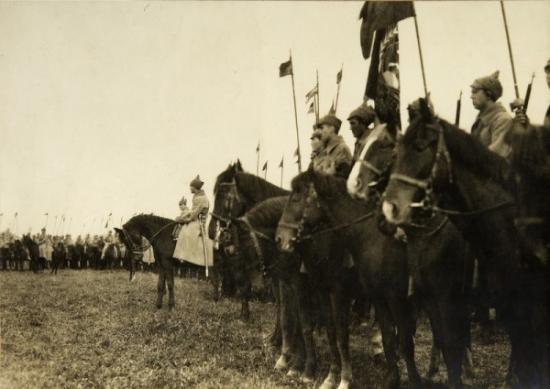
Budionny’s Konarmia.
“[By late June/early July 1920] Budionny’s spectacular advance had begun to run out of steam. His greatest assets – speed and mystique – had been eroded by the need to slow down and fight. After the initial reactions of panic and desertion, the Polish troops facing him had steadied and become battle-hardened. … This was not what Budionny and his men had anticipated when they began their invasion of Poland. They had been told that they were being sent to liberate the Ukrainian and Polish workers from the ‘Polish Lords’, and had expected to be received as heroes. They had also been led to believe that they would be marching through a land rich in the luxuries of ‘bourgeois’ life. In the event, they found themselves having to fight every inch of the way against determined troops who were self-evidently not all ‘Polish Lords’. Their march took them through poverty-stricken countryside ravaged by years of war, dotted with villages made up squalid hovels and ramshackle towns populated mainly by Jews. While some of the younger peasants and Jews welcomed and even joined them, most viewed them with puzzled apprehension. … As well as killing obvious ‘enemies of the people’, such as priests and landowners, [the Red soldiers] also raped and murdered civilians at random. Their officers insisted that they treat the Jews with forbearance, but once night fell, there was no stopping the rapine. They also massacred prisoners of war, often just for their boots or their uniforms. They were depressed and morale was not good, and they were also sick. Many suffered from dysentery and, according to the writer Isaac Babel … every single one of them had syphilis.” (A. Zamoyski, Warsaw 1920, Lenin’s failed conquest of Europe [2008] p. 59-60)