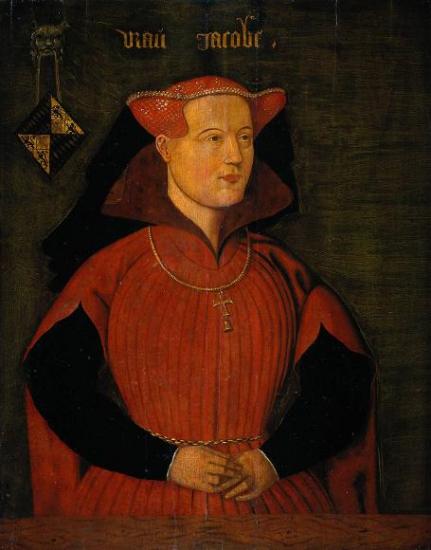
Jacoba van Beieren (1401-1436), gravin van Holland, Zeeland en Henegouwen 1417-1433
Jacoba verliet haar man, Jan IV van Brabant, in 1420. “The reasons for her flight from Brussels on 11 April 1420 were complex. The human element was probably more important than politics and, to domestic or sexual incompatibility between herself and her husband, must be added a whole series of grievances. … At first, the situation resulting from this marital disaster was scarcely dangerous for Philip [the Good, duke of Burgundy], though he did his best to reconcile the estranged couple. But Jaqueline’s dramatic flight to England early in 1421 and, above all, her marriage to Duke Humphrey of Gloucester [brother of Henry V and uncle of Henry VI] late in 1422, raised the spectre of immediate English intervention in the Low Countries, and the possiblility of future English rule in Hainault, Holland and Zeeland. … By the spring of 1423 Humphrey was using the title count of Hainault, Holland and Zeeland, while Pope Martin V’s commission of cardinals was still examining the validity of Jaqueline’s first marriage [to her cousin John IV of Brabant]. Since Rome dithered, Jaqueline had her second marriage confirmed at Peniscola, where the half-forgotten anti-pope, Benedict XIII, still obstinately maintained his own supremacy. … Duke Humphrey of Gloucester was in fact [in 1424] raising troops in England with a view to seizing or conquering Hainault from John IV of Brabant. While Philip the Good and John, duke of Bedford [uncle of king Henry VI] were still trying to achieve a diplomatic settlement, Humphrey and Jaqueline crossed the Channel to Calais [in Oct. 1424]. … [They] gained control of most of Hainault in the autumn of 1424 without even using the army they had brought from England. They set up their government at Mons. … Early in March [1425], the Burgundian-Brabantine army advanced into [Humphrey’s] newly won but weakly held territories [and in the middle of March took the town of Braine-le-Comte, on the main road from Brussels to Mons]. … [In early March Philip had challenged Humphrey] to a single combat with either King Sigismund [of Germany] or John, duke of Bedford, as judge, and pompously hinting that young knights like themselves should settle their differences by personal combat rather than by waging public war, with all the slaughter it entailed. … Humphrey, furnished with suitable safe-conducts by Philip, abandoned both his newly won county of Hainault and his wife Jaqueline, and returned to England. His exact motives for this desertion of wife and territory are obscure, but he took with him to England one of Jaqueline’s ladies-in-waiting, the beautiful Eleanor Cobham, whom he subsequently married. Jaqueline was left more or less besieged in Mons, in a sitiation which was politically and militarily hopeless. … In the summer of 1425 a concentrated diplomatic offensive directed against the deserted and beleaguered Jacqueline culminated in a striking, if temporary Burgundian victory. It was agreed that Philip, having got hold of Jacqueline’s person, should keep her in his care, and therefore virtually a prisoner, until the pope had decided whether she was married to Humphrey or to John IV of Brabant. Meanwhile she was excluded from the government of her own territories. At the same time Philip persuaded John IV to share the administration of Hainault with him and to transfer that of Holland to him for at least twelve years. … [Jacqueline] had appealed to Humphrey early in June for his immediate intervention on her behalf. There was no response, and she had to submit to being placed under house arrest at Ghent while Philip prepared to take control of Holland. At 5.0 a.m. on 2 September 1425, the very moment when Philip was arranging her transfer to Lille, where she would have been far more securely in his power, Jacqueline contrived a dramatic escape from Ghent dressed as a man. Galloping thence to Antwerp, she made her way to Gouda to rally and inspire the forces of opposition, in Holland, to the Burgundian seizure of the country.(Robert Vaughan, Philip the Good [London 1970], p. 34-40)