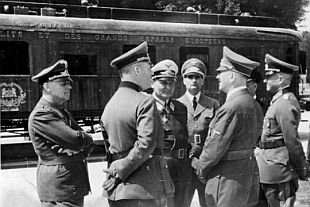
“Late on the afternoon of June 19 [1940] I [William Shirer] drove [to the Forest of Compiegne] and found German Army engineers demolishing the wall of the museum where the old wagon-lit of Marshal Foch, in which in the 1918 armistice was signed, had been preserved. By the time I left, the engineers, working with pneumatic drills, had torn the wall down and were pulling the car out to the tracks in the center of the clearing on the exact spot, they said, where it had stood at 5 A.M. on November 11, 1918, when at the dictation of Foch the German emissaries put their signatures to the armistice. … It was one of the loveliest summer days I ever remember in France. … At 3:15 P.M. precisely, Hitler arrived in his big Mercedes, accompanied by Goering, Brauchitsch, Keitel, Raeder, Ribbentrop and Hess, all in their various uniforms … They alighted from their automobiles some two hundred yards away, in front of the Alsace-Lorraine statue, which was draped with German war flags so that the Fuehrer could not see … the large sword, the sword of the victorious Allies of 1918, sticking through a limp eagle representing the German Empire of the Hohenzollerns. Hitler glanced at the monument and strode on. ‘I observed his [I wrote in my diary]. It was grave, solemn, yet brimming with revenge. There was also in it, as in his springy step, a note of the triumphant conqueror, the defier of the world. There was something else … a sort of scornful, inner joy at being present at this great reversal of fate – a reversal he himself had wrought.’ … Hitler and his party then entered the armistice railway car, the Fuehrer seating himself in the chair occupied by Foch in 1918. Five minutes later the French delegation arrived, headed by General Charles Huntziger, commander of the Second Army at Sedan, and made up of an admiral, an Air Force general and one civilian, Léon Noël, the former ambassador to Poland … They looked shattered, but retained a tragic dignity. They had not been told that they would be led to this proud French shrine to undergo such a humilition, and the shock was no doubt just what Hitler had calculated. … The French, one saw at once, were certainly dazed. Yet, contrary to the reports at the time, they tried, as we now know from the official German minutes of the meetings found among the captured Nazi secret papers, to soften the harsher portions of the Fuehrer’s terms and to eliminate those which they thought were dishonorable. But they tried in vain. Hitler and his entourage left the wagon-lit as soon as General Keitel had read the preamble of the armistice terms to the French, leaving the negotations in the hands of the OKW Chief, but allowing him no leeway in departing from the conditions which he himself had laid down. … At 6:50 P.M. on June 22, 1940 Huntziger and Keitel signed the armistice treaty.” [The old railway car was moved to Berlin on July 8. Ironically, it was destroyed in an allied bombing of Berlin later in the war.] (W. L. Shirer, The Rise and Fall of the Third Reich, [Secker and Warburg 1978], p. 741 e.v.]