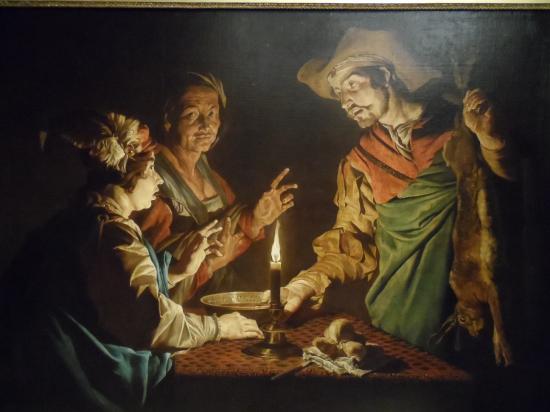
Matthias Stom, Esau verkoopt zijn eerstgeboorterecht van Jacob, ca. 1645, Hermitage Amsterdam 23 okt. 2017
Birth of Esau
Edit
Genesis 25:25 narrates Esau’s birth, “Now the first came forth red, all over like a hairy garment; and they named him Esau.”[11] The meaning of the word esau is disputed. It could be related to the Arabic root ġšw, meaning “to cover.”[12] Others have noted the similarity to Arabic ’athaa (عثا) meaning “hirsute”.[13] In Hebrew, the word “hairy” (Heb: se’ir) is a wordplay on Seir,[10] the region in which he settled after being 40 years of age. The name Edom is also attributed to Esau, meaning “red” (Heb: `admoni);[10] the same color used to describe Esau’s skin tone.[14] Genesis parallels his redness to the “red lentil pottage” that he sold his birthright for.[15][1] Esau became the progenitor of the Edomites in Seir.
Birthright
Edit
Esau and Jacob Presented to Isaac (painting circa 1779–1801 by Benjamin West)
In Genesis, Esau returned to his twin brother Jacob, famished from the fields. He begs Jacob to give him some “red pottage” (a play on his nickname, Hebrew: אדום`Edom, meaning “red”.) This refers to his red hair.[16] Jacob offers Esau a bowl of lentil stew[a] in exchange for Esau’s birthright (Hebrew: בְּכֹרָה bəḵōrāh, the right to be recognized as firstborn son with authority over the family), and Esau agrees. Thus Jacob acquires Esau’s birthright. This is the origin of the English phrase “for a mess of pottage”.
In Genesis 27:1–40, Jacob uses deception, motivated by his mother Rebecca, to lay claim to his blind father Isaac’s blessing that was inherently due to the firstborn, Esau.
In Genesis 27:5–7, Rebecca is listening while Isaac speaks to his son Esau. When Esau goes to the field to hunt for venison to bring home, Rebekah says to her son Jacob, “Behold, I heard thy father speak to thy brother Esau, saying: ‘Bring me venison and prepare a savoury food, that I may eat, and bless thee before the Lord before my death.'” Rebecca then instructs Jacob in an elaborate deception through which Jacob pretends to be Esau, in order to steal from Esau his blessing from Isaac and his inheritance — which in theory Esau had already agreed to give to Jacob. Jacob follows through with the plan to steal his brother’s birthright by bringing the meal his father Isaac requested and pretending to be Esau. Jacob pulled off his disguise by covering himself in hairy lamb skin so that when his blind father went to touch him, his smooth skin did not give him away as an imposter of his hairy brother. Jacob successfully received his father Isaac’s blessing. As a result, Jacob becomes the spiritual leader of the family after Isaac’s death and the heir of the promises of Abraham (Genesis 27:37).
When Esau learns of his brother’s thievery, he is livid and begs his father to undo the blessing. Isaac responds to his eldest son’s plea by saying that he only had one blessing to give and that he could not reverse the sacred blessing. Esau is furious and vows to kill Jacob (Genesis 27:41). Once again Rebecca intervenes to save her younger son from being murdered by his elder twin brother, Esau.
Therefore, at Rebecca’s urging, Jacob flees to a distant land to work for his uncle Laban (Genesis 28:5). Jacob does not immediately receive his father’s inheritance after the impersonation aimed at taking it from Esau. Having fled for his life, Jacob has left the wealth of Isaac’s flocks, land and tents in Esau’s hands. Jacob is forced to sleep out on the open ground and then work for wages as a servant in Laban’s household. Jacob, who had deceived and cheated his brother, is in turn deceived and cheated by his uncle. Jacob asks to marry Laban’s daughter Rachel, whom he has met at the well, and Laban agrees, if Jacob will give him seven years of service. Jacob does so, but after the wedding finds that beneath the veil is not Rachel but Leah, Laban’s elder daughter. He agrees to work another seven years and Jacob and Rachel are finally wed. However, despite Laban, Jacob eventually becomes so rich as to incite the envy of Laban and Laban’s sons.
Francesco Hayez: Esau and Jacob reconcile (1844)
Genesis 32–33 tells of Jacob’s and Esau’s eventual reconciliation. Jacob sends multiple waves of gifts to Esau as they approach each other, hoping that Esau will spare his life. Esau refuses the gifts, as he is now very wealthy and does not need them. Jacob never apologizes to Esau for his actions; Jacob nevertheless bows down before Esau and insists on his receiving the gifts. Esau shows forgiveness in spite of this bitter conflict. (After this, God confirms his renaming of Jacob as “Israel”.) (Wikipedia)