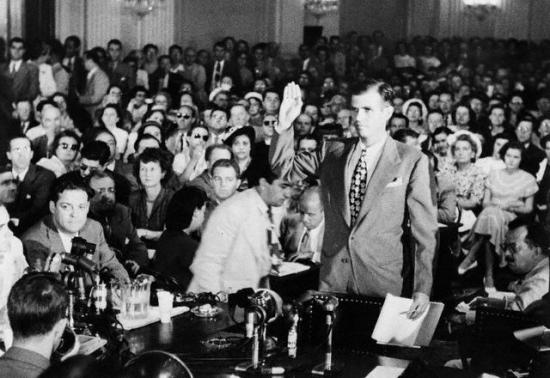
Alger Hiss.
“In a KGB message deciphered by the Venona project it is noted that ‘1. Ales has been working with the Neighbors [= the GRU] continuously since 1935.’ [Volgens Whittaker Chambers begon Hiss documenten te stelen in 1935.] ‘2. For some years past he has been the leader of a small group of the Neighbors’ probationers [= agents], for the most part consisting of his relations.’ [nl. zijn vrouw Priscilla, die vele van de gestolen documenten overtypte en zijn broer Donald, die eveneens op het State Department werkte.] ‘3. The group and Ales himself work on obtaining military information only. Materials on the Bank [= State Department] allegedly interest the Neighbors very little and he does not produce them regularly.’ ‘6. After the Jalta Conference, when he had gone on to Moscow, a Soviet personage in a very responsible position (Ales gave to understand that it was Comrade Vishinski [deputy foreign minister of the USSR] allegedly got in touch with Ales and at the behest of the Military Neighbors passed on to him their gratitude and so on.” Er waren slechts vier diplomaten, die na de Conferentie van Jalta via Moskou (na een korte stop) naar Washington terugkeerden: minister van BZ Stettinius, H. Freeman Matthews, director of the office of European Affairs, Wilder Foote, Stettinius’ press aide en Hiss. [Haynes en Klehr, Venona (1999), p. 171-172.]
“… in 1993, the State Department declassified documents relating to a security investigation in 1946 that disclosed Hiss had procured top secret reports he was not authorised to see – on atomic energy, China policy, and other matters relating to military intelligence. Two weeks later [na het onderzoek] Hiss notified John Foster Dulles he was available, after all, to head the Carnegie Endowment.” [Tannenhaus, Whittaker Chambers. A Biography.(1998), p. 519]In 1995, the CIA and the NSA for the first time made public the existence of the World War II Venona project, which, beginning in 1943, had decrypted or partially decrypted thousands of telegrams sent from 1940 to 1948 to the primary Soviet foreign intelligence agency—for most of that period, the NKVD—by its U.S. operatives. Although known to the FBI, VENONA had been kept secret even from President Truman. One cable, Venona #1822, mentioned a Soviet spy codenamed “ALES” who worked with a group of “Neighbors”—members of another Soviet intelligence organization, such as the military’s GRU. FBI Special Agent Robert J. Lamphere,[108] who supervised the FBI’s spy chasing squad, concluded that the codename “ALES” was “probably Alger Hiss”.[109][110]
In 1997, Allen Weinstein, in the second edition of his 1978 book Perjury: The Hiss-Chambers Case, calls the Venona evidence “persuasive but not conclusive”.[14] The bipartisan Moynihan Commission on Government Secrecy, chaired by Democratic Senator Daniel Patrick Moynihan, however, stated in its findings that year: “The complicity of Alger Hiss of the State Department seems settled. As does that of Harry Dexter White of the Treasury Department.”[111] In his 1998 book Secrecy: The American Experience, Moynihan wrote, “Belief in the guilt or innocence of Alger Hiss became a defining issue in American intellectual life. Parts of the American government had conclusive evidence of his guilt, but they never told.”[112] In their numerous books, Harvey Klehr, professor of political science at Emory University, and John Earl Haynes, historian of twentieth-century politics at the Library of Congress, have mounted an energetic defense of Lamphere’s conclusion that ALES indeed referred to Alger Hiss.[113] National Security Agency analysts have also gone on record asserting that ALES could only have been Alger Hiss.[114] The Venona transcript # 1822, sent March 30, 1945, from the Soviets’ Washington station chief to Moscow,[110] appears to indicate that ALES attended the February 4–11, 1945, Yalta conference and then went to Moscow. Hiss did attend Yalta and then traveled to Moscow with Secretary of State Stettinius.[115]
Some, however, question whether Venona #1822 constitutes definitive proof that ALES was Hiss. Hiss’s lawyer, John Lowenthal argued:
ALES was said to be the leader of a small group of espionage agents but, apart from using his wife as a typist and Chambers as courier, Hiss was alleged by the prosecution to have acted alone.[116] The CIA, however, concluded the “small group” comprised Alger, his wife Priscilla, and brother Donald.
ALES was a GRU (military intelligence) agent who obtained military intelligence and only rarely provided State Department material. In contrast, during his trial, Alger Hiss, an employee of the State Department, was accused having obtained only non-military information, and the papers he was accused of having passed to the Soviets on a regular basis were non-military, State Department documents.
Even had Hiss been a spy as alleged, after 1938 he would have been unlikely to have continued espionage activities as ALES did, since in 1938 Whittaker Chambers had broken with the Communist Party and gone into hiding, threatening to denounce his Communist Party colleagues unless they followed suit. Had Hiss been ALES, his cover would thus have been in extreme jeopardy and it would have been too risky for any Soviet agency to continue using him.[117]
Lowenthal suggests that ALES was not at the Yalta conference at all and that the cable instead was directed to Soviet deputy foreign minister Andrey Vyshinsky.[118] According to Lowenthal, in paragraph six of Venona #1822, the GRU asks Vyshinsky to get in touch with ALES to convey thanks from the GRU for a job well done — which would have been unnecessary if ALES had actually gone to Moscow, because the GRU could have thanked him there in person.[107]
Eduard Mark of the Center for Air Force History hotly disputed this analysis.[119] In 2005, NSA released the original Russian of the Venona texts. At a symposium held at the Center for Cryptologic History that year, intelligence historian John R. Schindler concluded that the Russian text of Venona #1822 made clear that ALES was indeed at Yalta: “the identification of ALES as Alger Hiss, made by the U.S. Government more than a half-century ago, seems exceptionally solid, based on the evidence now available; message 1822 is only one piece of that evidence, yet a compelling one.”[120]
Rebutting Lowenthal’s other points, John Earl Haynes and Harvey Klehr argued that:
None of the evidence presented at the Hiss trial precludes the possibility that Hiss could have been an espionage agent after 1938 or that he had only passed State Department documents after 1938.
Chambers’s charges were not seriously investigated until 1945 when Elizabeth Bentley defected, so the Soviets could in theory have considered it an acceptable risk for him continue his espionage work even after Chambers’s 1938 defection.
Vyshinsky was not in the U.S. between Yalta and the time of the Venona message, and the message is from the Washington KGB station reporting on a talk with ALES in the U.S., rendering Lowenthal’s analysis impossible.[121]
An earlier Venona document, #1579, had actually mentioned “HISS” by name. This partially decrypted cable consists of fragments of a 1943 message from the GRU chief in New York to headquarters in Moscow and reads: “from the State Department by name of HISS” (with “HISS” “spelled out in the Latin alphabet”, according to a footnote by the cryptanalysts). “HISS” could refer either to Alger or Donald Hiss, both State Department officials at that time. Lowenthal argued that had Alger Hiss really been a spy, the GRU would not have mentioned his real name[107] in a coded transmission, since this was contrary to their usual practice.[113]
At an April 2007 symposium, authors Kai Bird and Svetlana Chervonnaya postulated that, based on the movements of officials present at Yalta, Wilder Foote, a U.S. diplomat, not Hiss, was the best match for ALES.[122] They note Foote was in Mexico City when a Soviet cable placed ALES there, whereas Hiss had left several days earlier for Washington (see above). In response, Haynes and Klehr point out that Foote doesn’t fit other aspects of the description of ALES (Foote was publishing newspapers in Vermont at the time when “ALES” was said to have been working for Soviet military intelligence) and suggest that the cable came from someone who managed KGB assets (rather than GRU assets like ALES) and may have been mistaken when he stated that ALES was still in Mexico City.[123][124](Wikipedia s.v. Alger Hiss)