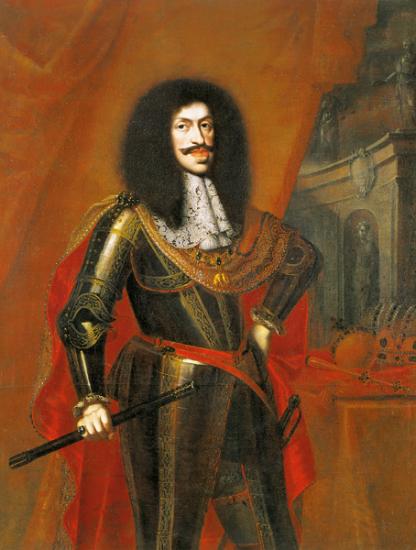
Leopold I van Oostenrijk (1640-1705)
“Just as Louis [XIV of France] moved to occupy Lorrain [in 1670] it became clear that Charles II of England had reached an understanding with France. Faced with a diplomatic impasse, without troops of his own and money to pay them, Leopold agreed to make a deal with France, signing a secret treaty of neutrality on 13 November 1671 which in effect left Louis XIV free to attack the Dutch from the west, outflanking the strong Spanish frontier fortresses. When the invasion began in April 1672, however, it created a situation which suddenly changed the diplomatic picture and showed the flaws in the apparent perfection of French preparations. The first to break with France was the elector of Brandenburg … Friedrich Wilhelm tried but failed to stir up the Protestant princes of Germany, then turned to Austria. In Vienna the mood was changing rapidly. The Hungarian rebellion was suppressed, the war in the west grew more dangerous. In June 1672 Leopold signed a treaty with Brandenburg binding each to have 12.000 men in arms within two months for the defence of the Empire. It was a purely defensive league, mentioning neither the French nor the Dutch; but it was a move away from the eastern orientation of Austrian policy, a step that Leopold himself found heartening. This new direction in Vienna was hailed by the Spanish faction, for in February 1672 Spain had unexpectedly joined its former rebellious Dutch provinces. This alliance strengthened Leopold’s instinctive wish to help the Dutch against the French; Austria and Spain both seemed to be moving once more in the same direction to protect the [Habsburg] family enterprise. … As Vienna learned of repeated French successes in the United Provinces, Leopold agreed to send [general] Montecuccoli with a small force to the Rhine, hoping that his presence there would divert the French while Lisola negotiated an alliance with the Dutch. Montecuccoli’s bluff failed to impress the French, who insolently demanded that Leopold hold to the treaty of 1671, disarm and recall his troops. … Montecuccoli returned to Vienna from his fruitless demonstration on the Rhine in April 1673 … For Austria the crucial diplomatic move came in August 1673 when a treaty between Leopold and his Spanish relations brought promise of the cash subsidies he needed to bring his army up to a size large enough to operate openly against France. Within four weeks the Imperial forces marched to the Rhine while Leopold addressed an emotional call to the Imperial Diet to bestir itself to defend the Empire against France. The war thus began was to last for the rest of Leopold’s reign with but two interludes of armed peace from 1679 to 1688 and again from 1697 to 1700. … He still remained suspicious of the Protestant sea powers, reluctant to combine with them against Catholic France however much he hated Louis XIV. Until he could overcome these qualms of conscience – and the Spanish alliance with the Dutch helped move him in this direction – he remained without strong allies in the west, trapped by constant threats arising on his eastern frontiers. Once Leopold did master the fundamental political necessity of uniting his human and material potential with the commercial wealth of England and the Dutch Republic, the house of Austria’s future as a great power was assured.” (J.P. Spielman, Leopold I of Austria [London 1977], p. 58 et seq.]