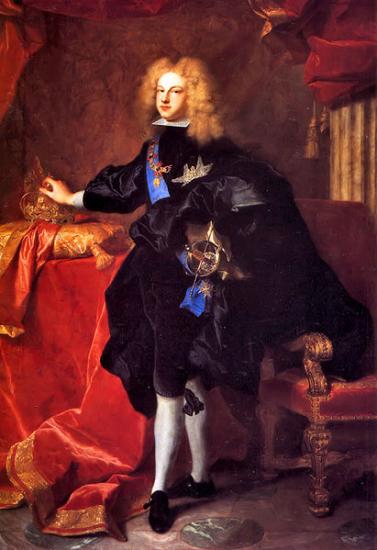
Filips V van Bourbon-Anjou, koning van Spanje (1700-1724, 1724-1746)
“… the elaborate plans erected by the great powers fell like a house of cards from the whiff of Carlos II’s [king of Spain 1665-1700] dying breath on 1 November 1700. Carlos II’s greatest concern was to keep his lands intact, and so he contrived to avoid their partition by willing them to Louis [XIV]’s grandson, Philippe of Anjou [grandson of Louis’s wife, Maria Theresia of Austria, daughter of Philip IV of Spain]. The Spanish court had brought up Philippe’s name because he was not immediately in line for the French throne [his father and elder brother were still alive]… so granting him the Spanish inheritance would not unite France and Spain. Still, bequeathing Philippe the entire inheritance [Spain, the Spainish Netherlands, Spain’s possessions in Italy,and her colonies] would enlist Louis and the power of France to guarantee the settlement. … [Philippe’s father, the dauphin, and his brother, the duke of Burgundy] set aside their claims in favour of Philippe, making him the legitimate Bourbon candidate, and Louis accepted the will. [If the Bourbons would have refused, the Spanish would have offered the whole Spanish inheritance to Archduke Charles, the second son of Emperor Leopold I.] Throughout this manoeuvering, Louis’s goals remained essentially dynastic, that is, securing lands for his son, and later his grandson, not himself. True, the partition treaties of 1698 and 1700 would have added territory to France, but only when the dauphin succeeded Louis. Moreover, by accepting the will of Carlos II, Louis forwent any territorial addition to France, then or in the future. In fact, Louis would later insist that accepting the will was a principled and selfless act because it meant abandoning a partition treaty that would have eventually added important domains to France. Louis had probably little reasonable choice but to accept the will of Carlos II, even thogh this act would make war with the Habsburgs almost unavoidable. If he had abided by the partition treaty of 1700, which the Habsburg emperor refused to sign in any case, he would have faced a Habsburg succession and occupation in Spain. Louis would have had to fight Leopold just to gain the scraps that the treaty allowed Philip, and he would have had to attack the combined forces of Spain and the Empire to get them. And who is to say that England and the Dutch would have aided him in enforcing the treaty. By accepting the will, he would still have to fight Leopold I, but he could fight a defensive war on Spanish territory, with French and Spanish force allied against the emperor. The trick was to convince the Maritime Powers that Louis really had no choice and that his goal was purely dynastic. But Louis now misplayed his cards. After recognizing his grandson as king of Spain, Louis issued letters patent declaring that Philip retained his right to succeed to the French throne. This was not an attempt on Louis’s part to unite the crowns of France and Spain as his enemies feared. In fact Carlos’s will stipulated that the new Spanish king must reside in Madrid, and this alone made it impossible for one Bourbon to rule both countries. Louis’s decision expressed his belief that God established the principles of succession and that His choice must be honoured. … The English and Dutch probably could have lived with retaining Philip as a possible, albeit remote, claimant to the French throne, but Louis’s next move enraged William III [king of England, Scotland and Ireland, and stadhouder of the United Provinces]. The Sun King insisted on sending French troops to take over the [10] Dutch-held barrier forts in the Spanish Netherlands … From William’s perspective, losing this protective belt overturned the work of twenty years. Louis further alienated the English by having Philip V grant French Merchants the coveted asiento, the right to supply slaves to the Spanish colonies, and thus denying it to English merchants. And a final insult came when Louis acclaimed [deposed king of England] James II’s son as the legitimate king of England when the father died in September 1701. [In a certain sense the War of the Spanish Succession was also a war of the British Succession (ABdH] … A case might be made for each of these decisions in isolation, but taken as a group the appeared overbearing. Louis seemed to have gone from penitent to arrogant with his acceptance of the Spanish will. … On 15 May 1702 England, the United Provinces, and Habsburg Austria declared war on France.” (John A. Lynn, The Wars of Louis XIV 1667-1714 [London/New York 1999], p. 268-270)
“in 1708 Louis mounted a naval expedition to land the Stuart claimant for the British throne in Scotland. At Dunkirk the French assembled a fleet of eight ships of the line, twenty-four frigates, and transport vessels under Chevalier de Forbin. The fleet carried twelve battalions of infantry and 13,000 fusils. 10,000 saddles and bridles, and a similar number of pistols for rebels who were expected to rise in support of the Stuart pretender [James III]. On 16 March the troops embarked, and the whole sailed a few days later, escaping the British naval forces attempting to blockade Dunkirk. On 25 March the French fleet reached the Firth of Forth, but the approach of the British fleet under Byng drove the French off before they could land the troops. The invasion fleet sailed north and attempted to put in at Inverness, but this too came to naught, and the ships sailed back to Dunkirk. Had the landings succeeded they would have, at the very least, diverted British troops from Flanders. In 1709 the French would again consider supporting an expedition to Scotland, but this scheme was shelved in January 1710 for lack of support and finances.” (id., p. 317-318)