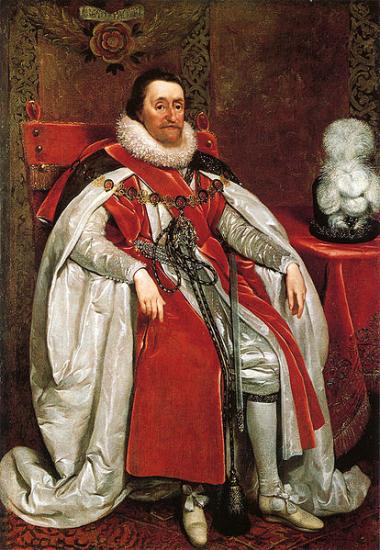
James I of England (1621)
“There could be no doubt that James was a convinced protestant, for he made this clear in his writings as well as his conversation. But there could also be no doubt that something, or someone, stood between him and wholehearted adherence to the cause of protestantism. [George] Abbot [archbishop of Canterbury],[William Herbert, Earl of] Pembroke, and many others believed that Somerset [Robert Carr, favourite of the King] was the major obstacle, and that with his removal the direction of the King’s policy would be altered. In this they were wrong, for James was his own policy-maker, and perhaps had a wider vision than they did. For him the proposed Spanish marriage [between his son Charles and the Infanta Maria Anna] was not simply a source of much-needed capital and a guarantee of his own security in case his subjects gave trouble; it was also a way of healing the tragic rift in Christendom that had opened with the Reformation in the sixteenth century.” (R. Lockyer, Buckingham. The life and political career of George Villiers, First Duke of Buckingham 1592-1628 [London, New York, 1981] p. 18-19)
“It is hard for anyone writing about [Sir Walter] Raleigh to be sympathetic towards James. The remark about him by Henri IV of France, ’the wisest fool in Christendom’, has stuck to him forever. … From the evidence of a contemporary, the admittedly hostile Sir Anthony Weldon, we learn that although James was peacable and merciful, witty and ‘ready with jests’, delivered with a poker face, he was ‘crafty in petty things’ and of ’timorous disposition’. He did indeed have a tongue too large for his mouth, which made watching him eat an unpleasant sight; and he was crippled, which meant that he had to walk leaning on somebody’s shoulder. He was terrified of assassination, with some good reasons from the past, and wore a padded doublet, proof against stilettos, and stuffed breeches, which apparently he only changed when they wore out. … He never washed his hands, only wiping his finger ends with a wet napkin, and was said to be constantly fiddling with his codpiece (fleas?). His language was sometimes coarse and blasphemous, and he drank heavily though never to excess. He must have smelt. His admiration for handsome youths was notorious. … For all that, James’s better qualities have recently been emphasized, notably his distaste for extremism and his desire to find a middle way in reform and politics.” (R. Trevelyan, Sir Walter Raleigh [London 2002], p. 357-358)”An event in 1607 which was to have a grave effect on Raleigh and his family was the sudden rise to eminence of Robert Carr or Kerr, then aged about twenty-one. He was a Scot and had been employed as a Groom of the Bedchamber: somewhat androgynous in appearance, pert, blue-eyed, fair-haired and virtually beardless. At the annual tournament held on the King’s accession day, 24 March, he had been thrown from his horse and had broken his leg. James was distraught and visited him constantly, finally falling in love. Within months Carr had been given property sequestered from a Catholic, with a pension of [600 pounds] a year (soon increased to 800 pounds). On 23 December he was knighted and promoted to Gentleman of the Bedchamber. There was no doubt any more at Court about James’s sexual inclinations.” (idem, p. 420)