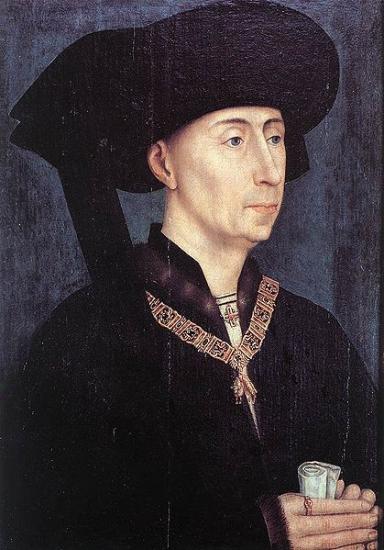
Philip the Good (1396-1467), hertog van Bourgondië (1419-1467)
“From September 1425 until April 1428 Philip never once visited France. The war in Holland occupied his person, his armies, his finances, to the exclusion of other interests. Hitherto, the military annals of Burgundy had comprised a mixed assortment of campaigns, sieges, and pitched battles. Now, for the first time, the duke waged a real war. A war of conquest and military occupation; a war which was in large measure a civil war, fought between places like Gouda, Oudewater en Schoonhoven and the aristocratic, feudal elements of the population, supporting Jacqueline, against the merchant cities and burgesses of Rotterdam, Amsterdam and Haarlem. Above all, it was a long, hard, costly war, which was only won because of the energy and determination of Philip the Good himself. … [By the early months of 1428] it must have long been apparent to Jacqueline that coming to terms with her cousin Philip the Good would mean abandoning her territories to him. The possibility of continuing the war indefinitely, especially with the help of Utrecht, was a real one; but Jacqueline could scarcely hope for an outright victory against the military might of Burgundy. At best, she might hope to achieve a sort of military stalemate, costly in lives and suffering, and not enabling her to enjoy possession of any significant part of her lands. She was determined and resourceful, but not obstinate. Her only hope of achieving her aim of obtaining possession of Holland or Hainault lay in English help; for Philip, had he been deserted by John, duke of Bedford, in France, and attacked by Humphrey, duke of Gloucester, in the Low Countries, would surely have been forced to sue for peace and to make significant territorial concessions to Jacqueline. In the early months of 1428 the whole basis of Jacqueline’s position, the sole justification of her endeavour, her English connection, was severed. The first blow, bitterest of all perhaps, was the final papal judgment in the affair of her double marriage, first to Duke John IV of Brabant, then to Duke Humphrey of Gloucester. On 9 January 1428 Pope Martin V ruled, finally and irrevocably, that her marriage to Duke John IV was alone valid. As if this were not enough, Humphrey took advantage of the sentence to marry his mistress, Eleanor Cobham, and demonstrated his complete loss of interest in Jacqueline’s affairs by cancelling an advance that was to have been made to him on the parliamentary subsidy granted in the previous summer to enable him to help her. The last straw, for Jacqueline, must have been the news that the earl of Salisbury was sailing with his army to France, instead of Holland, coupled with the siege that Philip laid, in the spring of 1428, to her headquarters at Gouda. She surrendered and, on 3 July 1428, signed the treaty of Delft, the main provisions of which were as follows: 1. Jacqueline renounced an appeal she had lodged at Rome against the papal judgment of 9 January 1428. 2. Philip recognized [her] … as countess of Hainault, Holland and Zeeland. 3. Jacqueline recognized Philip as her heir in these territories and appointed him their guardian and governor, with possesion of all the castles. 4. If Jacqueline married again, without the consent of her mother Margaret of Hainault, of Philip, and of the Estates of the three lands, or any one of them, her subjects were to cease obeying her and give their allegiance to Philip …” (R. Vaughan, Philip the Good [London 1970], p. 40-48)