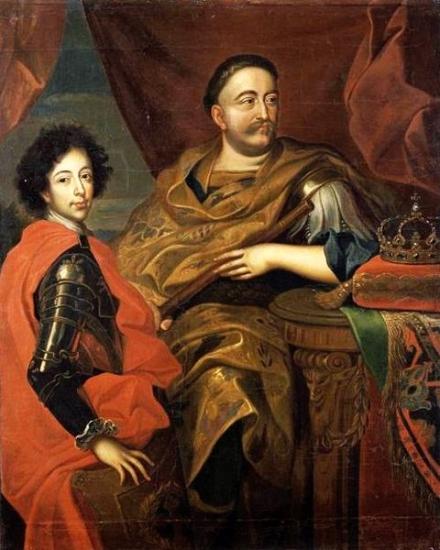
Jan III Sobieski, koning van Polen 1674-1696, en zijn zoon Jacob Lodewijk. “[Habsburg envoy Albert]Caprara’s reports from Istanbul had at last forced [emperor] Leopold to modify his old policy towards Poland. He gave up his objection to the plan of an offensive Alliance, once judged likely to provoke the Turks unnecessarily, and he prepared to buy the promise of a Polish military diversion in 1683, directed against Turkish positions around Kamenets [a city in Podolia, now part of Ukraine], which was to be supplemented by a promise of help if Vienna were attacked. John Sobieski secured financial help to ease the task of putting a Polish army in the field; and he gave up, at least for the time being, his old demands for the marriage of a Habsburg princess to his son Jacob. Having made these calculations, the two rulers and their advisers came to terms. Neither made any difficulty over a promise to put his troops in the field against the Turks in 1683, or over a further promise not to make peace without the other’s consent. The Poles wished to recover their previous losses in Podolia [in 1672]; and, for this, a combat in Hungary was needed in order to pin down the Turks west and south of the Carpathians. … Vienna … agreed to put 60,000 [men] into Hungary and to subsidise Sobieski, who agreed to raise a Polish army of 40,000. … they also arranged, if the worst imaginable possibility occurred and the Turks laid siege to either Vienna or Cracow, that the threatened government could call on the direct aid of its ally. … It remained for the two courts to coax and coerce the Polish Diet; no treaty pledging the Republic was valid without the Diet’s confirmation.” (J. Stoye, The Siege of Vienna [London 1964], p. 112-113)