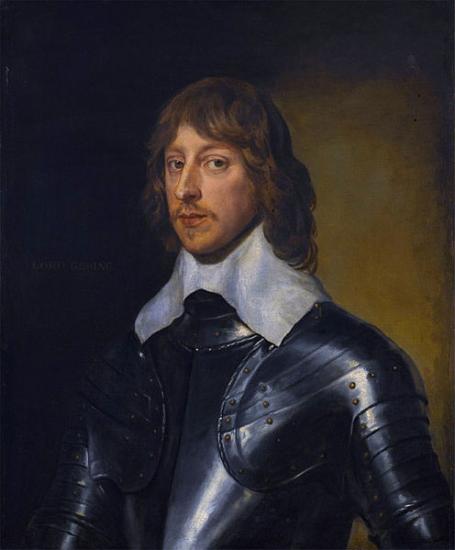
Lord George Goring (1608-1657), by Anthony van Dijk. “This young officer, a soldier by profession with five or six years’ experience, was the feckless eldest son of one of the Queen’s [Henrietta Maria] favourite servants, Lord Goring. As a young man he had caused his family … much anxiety … Young George … had never been troubled with religion; gaming and women were his undoing. His father had hoped that on his marriage to one of Lord Cork’s daughters he would settle down and perhaps make a career in Ireland, but the young man took neither to his wife nor his father-in-law and very soon outraged the family by departing withot notice on te best horse in the stable. He was later [1633] sent to the wars in the Netherlands to make good. Surprisingly, he did so; he had audacity, physical endurance, a quick judgment and the power to inspire his men. He had also an insinuating charm which he used to some purpose when he thought it worth his while, because, with all his wildness he was ambitious. In the two mismanaged campaigns against the Scots he had suffered the mortification of seeing his talents wasted and his ambitions checked by the incompetence of the high command. Since then, discontented with his post as governor of Portsmouth, he had intrigued to be made Lieutenant-General in the North where, should war again break out with Scotland, he believed he could conduct it with success. … [However] it suited the King and Queen better to keep him in Portsmouth. The Queen cherished baseless hopes of help from France, so that the necessity of keeping a royalist commander in the Portsmouth garrison was evident. … [In or about April 1641 Goring became involved in the so-called Army plot. His plan was more audacious than that of the other conspirators: he was for occupying London and seizing the Tower.] Some time in April George Goring, dubious about the success of the enterprise, the wisdom of his associates and the advantages to himself decided to put himself right with Parliament by betraying the plot. He sought out Lord Newport [Mountjoy Blount] and warned him of the growing conspiracy. Newport passed the information on to the Earl of Bedford … and to Lord Mandeville, … who passed it on to [leading Parliamentarian John] Pym. … Pym made no immediate use of his knowledge, knowing that its value hinged on the time at which he chose to make it public.” (C.V. Wedgwood, The King’s Peace 1637-1641, [London 1977], p. 369-371)