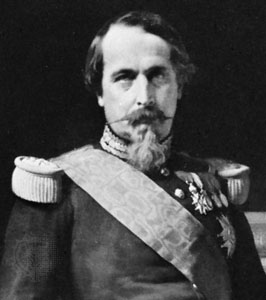
Napoleon III, keizer van Frankrijk
[On 25 dec. 1860 Benito Juarez’s army defeated Miramon and took over Mexico City. In July 1861 the British and French ministers in Mexico] were to be provided with a reason to call on their governments for an intervention, when the Mexican Congress issued a decree which included the suspension of payment of foreign debts for two years. (M. Cunningham, Mexico and the Foreign Policy of Napoleon III [New York 2001, p. 27 & 34)The talks between France and England [about an intervention in Mexico] having reached a stalemate, Napoleon decided the time had come to play an active role and state clearly his position regarding Mexico … he outlined his views in a lenghty letter to Flahault [French minister in London] early in October [1861]. He suggested that the obvious (‘ostensible’) aim of a combined intervention should be to obtain redress for their [Britain’s, France’s and Spain’s]complaints, but added … “We must anticipate what might happen, and not voluntarily tie our hands in such a way as to prevent a solution which would be in all our interests.” One could argue … that this was an attempt to leave himself free to impose a monarchy on Mexico. If this were so, why would he insist that he would only go to Mexico if England and Spain agreed to go too, and suggest the United States be involved ? Could it be that he intended manufacturing a situation whereby France would be left alone in Mexico to impose a monarchy headed by Maximilian [archduke of Austria] ? Such accusations have been made, yet how could he possibly guarantee that this would happen, and why go to the trouble of negotiating an entente he intended to break soon afterwards ? It is more reasonable to assume that Napoleon believed Spain and England were as committed as he was to seeing a stable and enduring government established in Mexico, and this seemed to be evident in their discussions so far. All three governments had been assured that there was a party of men who would be capable of instituting a new government if given support, and all Thouvenel’s [French minister of Foreign Affairs] and Napoleon’s arguments about the content of the Convention were with this in mind. … Without the establishment of a sound government to ensure that the same difficulties with Mexico did not continue, what was the point in going to Mexico ? Nothing in her republican history could instil any confidence in the three governments that such a stable government could emerge of its own accord and maintain itself for a long period of time without outside support. (id. p. 51-52) When discussing the idea of a monarchy Napoleon told Flahault that after being asked to name a possible candidate for the [Mexican] throne, the initiative had been taken from his own hands by the committee of Mexicans in Europe … “who are naturally pursuing things more eagerly than I am, and who are impatient to see events moving quickly” and who had already gone to Vienna to approach the Austrian government. … Napoleon did not condemn the Mexicans’ initiative, accepting their act as a fait accompli and deciding to work wit it. This is not to say he was determined to see Maximilian on the throne of Mexico. On the contrary, he was determined to act according to the desire of the Austrian government – that the wishes of the Mexican people had to be freely and loyally expressed in favour of Maximilian’s nomination – or an alternative government would be accepted … (id. p. 52) He concluded the letter by declaring that his only aim was to see French interests safeguarded for the future by a strong organisation in Mexico, and that helping a nation become prosperous was really working for the prosperity of everyone. … [He concluded his letter with: “In summary, I shall be delighted to sign, with England and Spain, a convention with the aim of redressing our grounds for complaint. However, it would be impossible, in all good faith, and knowing the state of affairs, to decide not to support, morally at least, a change which I strongly desire, because it is in the interests of the whole civilisation.” (id. p. 52-53)