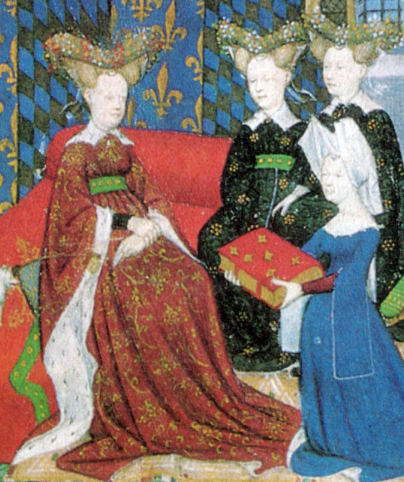
Christine de Pisan biedt haar boek aan Isabeau van Beieren, gemalin van Karel VI van Franrijk, aan.
“Charles VI married just before his seventeenth birthday. Although it was customary for kings to rely on portraits and descriptions furnished by ambassadors when selecting a foreign princess to wed, Isabeau of Bavaria was brought to meet the king in Amiens with no promise that he would actually marry her. Her father was outraged by this procedure, but the only concession made was that neither Isabeau nor the general public would know the true purpose of her trip. The meeting of July 14, 1385 was brief, and Isabeau, unable to speak French, said nothing to the king. Conversation proved unnecessary, however, for Charles was so attracted to her physically that nothing else mattered, and he insisted on an immediate wedding. It was decided that the ceremony should take place in nearby Arras, but he declared that he had to marry her as soon as possible in Amiens because his excitement was causing him sleepless nights. The wedding took place with little pomp three days after their first meeting. The fact that there was no marriage contract is another example of the king’s unconventional behavior. By not arranging to obtain a dowry from her father, Charles made Isabeau probably the only queen of France to be married without one. … Charles and Isabeau had twelve children,and Charles’s continued interest in sex after the onset of his illness [in 1392] is indicated by the fact that seven of the twelve were born after his first psychotic episode. Even during psychotic episodes Charles occasionally had a sexual appetite, but since he sometimes did not recognize the queen and seemed bothered by her presence, it was found expedient to provide him with a mistress of noble birth, Odette de Champdivers, who eventually bore him a thirteenth child. [She was called Margaret. In 1425 she went to live at the court of Charles VII, who legimitized her in 1428 and married her to Jean Harpedienne (R.C. Famiglietti, Royal Intrigue. Crisis at the Court of Charles VI 1392-1420. [New York 1986], p. 215-216, note 125)]… [On May 27, 1405] the Augustinian friar, Jaques Legrand, took it upon himself to deliver to [Isabeau]… a sermon in which he accused her court of moral corruption and attacked the extravagant fashions of which se was the “principal inventor”. He even claimed that the frivolous atmosphere of her court kept the knights and squires fromgoing to war for fear of disfiguring themselves. … The sermon Jaques Legrand preached to the queen has been misinterpreted by many historians and forms part of the ammunition used to dismiss her as frivolous and brand her an adulteress. From the information given by the Monk of Saint-Denis about the sermon, however, it appears that the only thing Legrand held against Isabeau personally was the fact that she had introduced new styles of dress which he could not approve.” (id., p. 41-42)