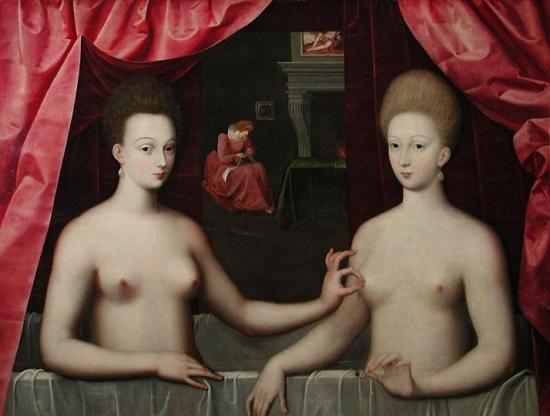
Gabrielle d’Estrées, maitresse van koning Hendrik IV van Frankrijk(rechts) in bad met haar zuster (Louvre, onbekende kunstenaar). In haar linkerhand heeft ze waarschijnlijk Hendriks diamanten kroningsring. “… in November 1590 the king had met Gabrielle d’Estrées at Coeuvres, in Picardy, and his political decisions at this juncture were greatly influenced by his desire to please her and to buy off her rapacious relations. So, instead of proceeding against Rouen [the League’s greatest stronghold in northern France after Paris], the king laid siege in February 1591 to Chartres, which was a town of modest strategic importance – it did contribute to the food-supply of Paris – but central to his amorous campaign. For its governor had until 1588 been Francois de Sourdis, uncle of Gabrielle; the governor of the surrounding pays chartrain had been Philippe Hurault, sieur de Cheverny, the lover of Sourdis’ wife … By his passion for Gabrielle, the king now found himself caught up in the intrigues of this very extended family. [After the surrender of Chartres] Sourdis and Cheverny were reinstated, and Gabrielle became the king’s constant companion.” (D. Buisseret, Henry IV [Londen 1984], p. 37-38)
“By the beginning of 1599 Henry’s political position was relatively strong. But he was already 46 years old, and had no recognised heir. The obvious first step in correcting this weakness was to obtain annulment of his marriage to Marguerite de Valois [Queen Margot], whom he had not seen since 1582. Marguerite had seemed inclined to be helpful when he was inquiring about this in 1593-4, but it was not until February 1599 that she actually agreed to refer the case to Rome. Meanwhile the king was more than ever infatuated with his delicious blonde, as somebody called her. His closest friends hesitated to interrogate him about his intentions, but by the beginning of 1599 most were convinced that he was seeking his divorce in order to marry her. … By the early spring of 1599 the matter was settled; according to the premier président of the Rouen parlement, ’the king meant to marry the Duchess about … [the Sunday after easter]’. To Henry, the advantages seemed considerable; not only would he marry the woman he most (and most often) loved, but he would also be able to have her two sons [César and Alexander de Vendome] legitimated, and so acquire instant heirs. Such were his fantasies. In fact, this arrangement would never have been approved by the Pope, and surely would have aroused such controversy among the French nobles that civil war might have followed Henry’s death. All the same, during February and March preparations were going on in Paris for the impending ceremony and, on Mardi Gras, Henry put on Gabrielle’s finger the diamond ring with which he had symbolically married France on the day on his anointing in 159[4].” She died however on Holy Saturday 1599 “of convulsions resulting from an aborted pregnancy.”(id. p. 77-78)