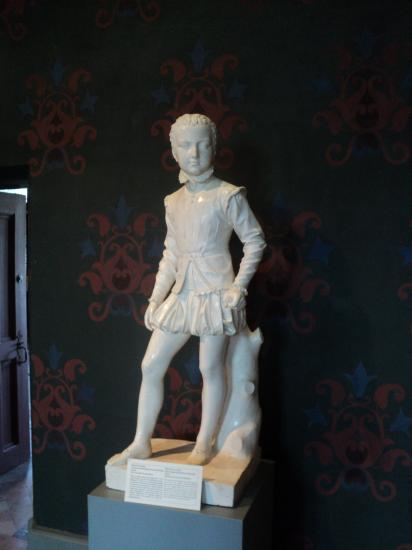
Hendrik IV van Frankrijk als kind (Chateau de Blois, kopie naar een marmeren origineel van F.-J. Bosio uit 1824, geschenk van zijn Hendriks nakomeling, Henri “V”, comte de Chambord, de legitimistische pretendent: foto A.B. den Haan juli 2011)
“in August 1560, when the prince was nearly seven, his mother [Jeanne d’Albret] took him back to the French court and to a situation which soon became disastrous for the unity of her family. [Henry’s father] Antoine [de Bourbon] had never been faithful to her, and he now began to act with spectacular infidelity. … He also quarelled with Jeanne over religious matters for, although he had leaned towards Protestantism even earlier than she, he had never summoned sufficient willpower to make a clean break with the ancient church; of course, his behaviour was largely influenced by considerations of political advantage. The quarrels between the couple became more and more scandalous until, in March 1562, Antoine ordered Jeanne to return to Béarn. Thus at the age of 8, Henry was thus separated from his mother, and left to fend for himself at court. Not content with that, his father began an assault on the prince’s religious beliefs, which he had acquired from his mother; his Protestant tutor was sent away and a Catholic one replaced him. For some weeks, Henry held out against this assault … But on 1 June 1562 he capitulated, accompanying his father to Mass and there swearing to observe the ancient faith. … To crown this year, so disastrous for the young prince, came news that his father had succumbed on 17 November to a wound which hemhad received at the siege of Rouen on 16 October. … Henry would now be at the court by himself for the next two years, for his mother could not venture up from Béarn to fetch or comfort him. However, he does seem at this juncture to have been kindly treated by the queen mother, Catherine de Medici, who saw to it that he got back his former Protestant tutors and other household officers; he was also now allowed to have Protestant services in his rooms, and was not required to attend Mass. … [From September 1568 at the Protestant headquarters at La Rochelle he came under the tutelage of his uncle Louis prince de Condé] and began seriously to develop his military skills. … The tutelage of Condé did not last long, for in March 1569 he was killed at (or, rather, after) the battle of Jarnac. Henry now became titular head of the Protestant cause, and as such was formally presented to the Protestant army by his mother.” (D. Buisseret, Henry IV [Londen 1984], p. 4-6)