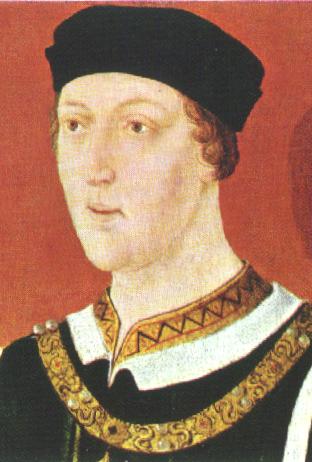
Henry VI (1421-1471), king of England 1422-1461, 1470-1471.
“Henry VI, at the unusually early age of sixteen, declared his minority at an end in November 1437, and claimed to rule in his own name. … Unfortunately, Henry VI was far from being the right man to cope effectively with the admittedly serious problems which faced an English ruler in 1437. … We know that he was a peace-loving man, who was notably more merciful on occasions than most of his contemporaries, and who did his limited best to heal the feuds among his great men. He was a faithful husband and a loving father; he was deeply religious and closely interested in education … but, at least according to his confessor, he became increasingly preoccupied with these interests at the expense of the less pleasing business of governing the realm. … One recent writer has argued persuasively that between 1437 and 1448 he intervened frequently, and with disastrous results, in the conduct of foreign policy, and, moreover, seriously weakened the financial position and political reputation of the crown by an unprecendentedly lavish distribution of titles, offices, lands and pensions to the friends who surrounded him in 1437 and later. The result was to create an entrenched court party which had a vested interest in keeping control of the king’s person and excluding all its rivals from access to him. It is doubtful, however, whether this activity persisted into the 1450s, when he seems to become for most purposes a political cipher, more and more under the control of his counsellors and of his French wife, the high-spirited, autocratic and ruthless Margaret of Anjou. In 1453 he suffered a severe nervous breakdown, perhaps some legacy of the mental instability of his maternal grandfather, the Valois king, Charles VI of France. who had been a raving lunatic for years on end. What is certain is that Henry was notably lacking in the qualities of force of character and intelligence necessary to command the respect and fear of his great men, and that he soon came to be regarded, both by friends and critics, as excessively malleable to the wishes of whoever happened to have control of him at any particular time.” (Ch. Ross, The War of the Roses. A concise history [London 1976], p. 18-26)