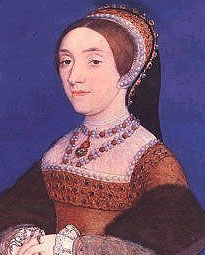
Katherine Howard (door Hans Holbein de Jongere): “Katherine Howard was the daughter of Norfolk’s [Thomas Howard, 3d duke of Norfolk] ineffectual brother, Lord Edmund Howard … She had been raised … in the household of the Dowager Duchess of Norfolk at Horsham in Norfolk and at Lambeth, where discipline had been so lax that she had compromised herself with two young men – one her music master, Henry Manox, when she was just eleven, the other her distant cousin, Francis Dereham, with whom she had been more deeply involved. Now aged about fifteen [in 1540], she was tiny in stature, very pretty, and old in the ways of love. … Any romantic feelings that Henry [VIII] may have cherished for Anne [Basset] were extinguished that spring [1540] when he began pursuing Katherine Howard. By Easter, his passion for her was notorious, and the Catholic party, led by Norfolk and Gardiner, hastened to capitalise on their good fortune. … Two almost identical miniatures by Holbein, thought to be of Katherine. survive today. They show a plump girl with auburn hair and the Howard nose, which bears out [the new French ambassador] Marillac’s assertion that she was ‘a young lady of moderate beauty but superlative grace, of small stature, of modest countenance and gentle, earnest face’. … On the day [Thomas] Cromwell died, 28 July 1540, the King secretly married Katherine Howard at Oatlands Palace … During the King’s illness in the spring [1541] Katherine had rashly begun a secret flirtation with Thomas Culpeper, which soon developed into something more serious. … On 27 August, … the net tightened around Katherine still further when her former lover, Francis Dereham, came to her seeking employment … Perhaps bowing to blackmail, the Queen made him her Private Secretary and Usher of her Chamber, but he proved a liability because he was prone to boasting arrogantly that, if the King died, that Katherine would marry him. He also hinted at the favours she had already granted him, thus arousing Culpeper’s jealousy.” Catherine was accused of adultery and beheaded near the Tower of London on 13 Febr. 1542. (A. Weir, Henry VIII. King and Court. [Londen 2002], p. 424,432-433, 451-452)