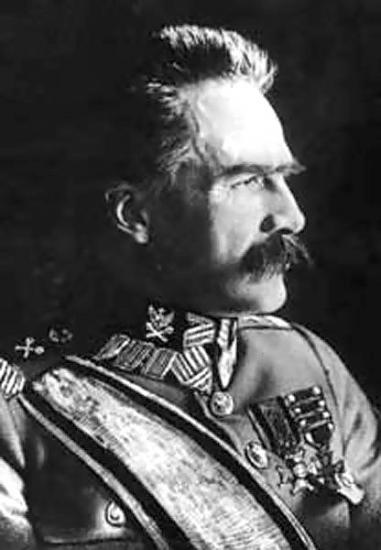
Jozef Pilsudski. “He was born in 1867 into the minor nobility and brought up in the cult of Polish patriotism. In his youth he embraced socialism, seeing in it the only force that could challenge the Tsarist regime and promote the cause of Polish independence. [… he had, at the age of nineteen, supplied Lenin’s elder brother with the explosives for the bomb which he had hurled at Tsar Alexander III.]His early life reads like a novel, with time in Russian and German gaols punctuating his activities as polemicist, publisher of clandestine newspapers, political agitator, bank-robber, terrorist and urban guerilla leader. In 1904 Pilsudski put aside political agitation in favour of para-military organization. He organized his followers into fighting cells that could take on small units of Russian troops or police. A couple of years later, in anticipation of the coming war, he set up a number of supposedly sporting associations in the Austrian partition of Poland which soon grew into an embryonic army. On the eve of the Great War Austro-Hungary recognized this as a Polish Legion, with the status of irregular auxiliaries fighting under their own flag, and in August 1914 Pilsudski was able to march into Russian-occupied territory and symbolically reclaim it in the name of Poland. He fought alongside the Austrians against Russia for the next couple of years, taking care to underline that he was fighting for Poland, not for the Central Powers. In 1916 the Germans attempted to enlist the support of the Poles by creating a kingdom of Poland out of some of the Polish lands, promising to extend it and give it full independence after the war. They persuaded the Austrians to transfer the Legion’s effectives, which had grown to some 20,000 men, into a new Polish army under German command … Pilsudski, who had been seeking an opportunity to disassociate himself from the Austor-German camp in order to have his hands free when the war ended, refused to swear the required oath of brotherhood with the German army, and was promptly interned in the fortress of Magdeburg. His legion was disbanded, with only a handful joining the [Polish army under German command] and the rest going into hiding. … Pilsudski was set free at the outbreak of revolution in Germany and arrived in Warsaw 11 November 1918, the day the armistice was signed in the west. … Piludski felt that thirty years spent in the service of his enslaved motherland gave him an indisputable right to leadership. His immense popularity in Poland seemed to endorse this. But that was not the view of the victorious Allies in the west, nor of the Polish National Committee, waiting in Paris to assume power in Poland. After some negotiation a deal was struck, whereby the … pianist Ignacy Jan Paderewski … who … was trusted by the leaders of [Britian, France and the USA], came from Paris to take over as Prime Minister, with Pilsudski remaining titular head of state and commander-in-chief. … While the Poles were being publicly urged by Lloyd George and Clemenceau to make peace [with the Bolsheviks], they were receiving conflicting messages from other members of the British government and from the French general staff … This suited Pilsudski, who continued to consilidate his own military position. On 3 January [1920] he captured the city of Dunaburg (Daugavpils) from the Russians and handed it over to the Latvians … thereby cutting Lithuania off from Russia. … Lenin was not interested in peace either. He mistrusted the Entente, which he believed to be dedicated to the destruction of the Bolshevik regime in Russia. He saw Pilsudski as their tool, and was determined to ‘do him in’ sooner or later. He feared a Polish advance into Ukraine, where nationalist forces threatened Bolshevik rule, and was convinced the Poles were contemplating a march on Moscow. Russia was isolated and the Bolsheviks’grip on power fragile. At the same time, the best way of mobilizing support was war, which might also allow Russia to break out of isolation and could yield some political dividends. … In the final months of 1919 Lenin increased the number of divisions facing Poland from five to twenty, and in January 1920 the Red Army staff’s chief of operations … produced his plan for an attack on Poland, scheduled provisionally for April. This was accepted by the Politburo on 27 January, although … Trotsky and … Chicherin warned against launching an unprovoked offensive. … Two weeks later, on 14 February, Lenin took the final decision to attack Poland, and five days after that the Western front command was created. … Operations, originally scheduled to begin in April, were delayed [however] by the need to disengage units from the fight against the remnants of Denikin’s [White] forces in the Caucasus and transfer them to the Polish theatre. This gave the Poles a chance. … On 25 April [1920] one Ukrainian and nine Polish divisions under the direct command of Pilsudski launched an offensive against the Russian South-Western Front in Ukraine … In just under two weeks [the Poles] had defeated two Soviet army groups, taken over 30,000 prisoners, captured huge quantities of materiel, moved the front forward by some two hundred kilometres and occupied [Kiev] the strategically and politically important capital of Ukraine. … But Pilsudski admitted to feeling uneasy. The operation had failed in its purpose. He had damaged the two Russian armies, but they had saved themselves by flight, and could be operational once more as soon as their losses had been made up. … [But this was nothing compared] to the blunder he had committed in diplomatic terms … [To the outside world the Polish offensive appeared as an unprovoked invasion of Russia. In early May 1920 a communist ‘Hands off Russia’committee in England] called for a boycott, the consequence of which was that dockers in the port of London refused to load a shipment of arms bound for Danzig … Large sections of world opinion swung against [Poland], and the Entente distanced itself. … Lloyd George was incensed, and even anti-Bolsheviks such as Churchill were annoyed that [Pilsudski] had struck now and not in the previous year, when he could have saved Denikin.” ” (A. Zamoyski, Warsaw 1920, Lenin’s failed conquest of Europe [2008], p. 4-38)