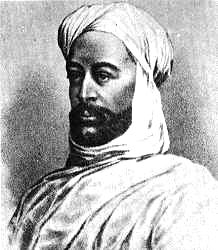
Muhammad Ahmad bin Abd Allah (August 12, 1844 – June 22, 1885), the Mahdi
“[He] was born in about 1844 on Lehab, a small island in the Nile near the town of Dongola [in Sudan]. His father, a boat builder, had been an ordinary artisan, but claimed descent from the Prophet Mohammed. … the boy had become a carpenter, but … decided to devote his life to Islam. From this path he never swerved. … Mohammed Ahmad’s asceticism and piety gradually attracted disciples, who clustered at his feet as he spoke. They would listen to him attentively until he seemed to drift off into a religious trance. Word began to spread that he could perform miracles. … He had also been blessed with a birthmark on his right cheek and a slight V-shaped gap between his two main front teeth, physical characteristics of the Prophet himself. … The circumstances in which Mohammed Ahmad became convinced that he was the Mahdi [the Messiah, who was believed to appear to purify the faith and offer salvation to the faithful] and the inspiration for this momentous decision may be debated, but the revelation seems to have taken place in the early summer of 1881. At least it was June 1881 when on Aba Island he publicly declared himself to be the Mahdi and set in motion one of the most astounding religious movements in history. … Mohammed Ahmad’s ascent to sainthood is believed to have occurred after a great vision, the details of which vary with the chronicler. Some say the Prophet gave Mohammed Ahmad his sword. Whatever miracles appeared to Mohammed Ahmad, he now believed he was the expected Mahdi, sanctified and mandated to go forth as Allah’s Imam on earth. Mohammed Ahmad not only claimed to be the Mahdi,but canonized himself Imam and Successor to the Apostle of God as well. As the Successor, he believed he must replay the role of the Prophet and unify Islam once again. As Imam, he saw himself as leader of all Moslems … As Mahdi Mohammed Ahmad would preside at the Day of Judgment when the end of the world approached. Accepted theology did not inhibit Mohammed Ahmad. He was a fundamentalist who preached a simple message: Trust in God, be faithful in the observance of Islam, be humble, and adhere to a rigid code of ethics. A place in heaven would await the faithful who accepted this. …” (John H. Waller, Gordon of Khartoum. [New York 1988], p. 301 et seq.)