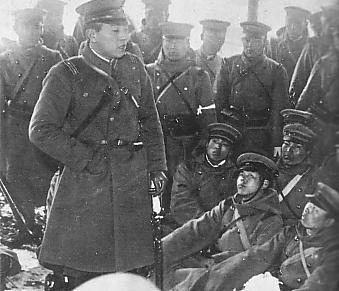
“On the snowy morning of February 26, 1936, about 1,400 Japanese troops, led by junior officers, seized the center of Tokyo and murdered a number of prominent officials. The rebels announced that they would not retreat until a new cabinet bent on carrying out sweeping reforms was set up.”(Ben-Ami Shillony, Revolt in Japan. The Young Officers and the February 26, 1936 Incident [Princeton Univ. Press 1973], p. IX) “It was a tragic irony for the rebels that among the opponents to the Showa Restoration [that was demanded by the rebels] was the Showa Emperor [Hirohito] himself. The man to whom the rebels had expressed ultimate loyalty and who was to lead their new Japan turned out to be an uncompromising adversary of the rebellion, refusing to regard it as anything but a criminal mutiny. When, in the early morning of February 26, Chamberlain Kanroji awakened the Emperor and told him the news, Hirohito reacted with a furor that the Chamberlain had never seen. Some time later, the Emperor told his chief aide-de-camp: “They have killed my advisers and are now trying to pull a silk rope around my neck … I shall never forgive them, no matter what their motives are.” (Idem, p. 172-173)