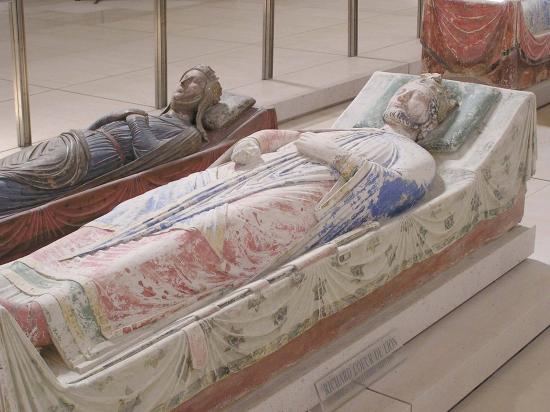
Graftombe van Richard I Leeuwenhart, koning van Engeland (1189-1199)
“On 31 October 1191 Richard left Jaffa and began the last stage of his journey to Jerusalem. … By 22 November the main army had reached Ramlah and there stayed for six weeks while the winter rain beat steadily down. The difficulties of campaigning in this kind of weather meant that winter was traditionally the season when armies were disbanded and soldiers went home. Saladin kept his army together until 12 December, but he was at last compelled to give way before pressure of his emirs and their troops and the threat of deteriorating morale. When he learned that the bulk of Saladin’s army had dispersed, Richard moved his headquarters up to Latroun. Here he spent Christmas and then ordered the main crusading army to advance up to Beit Nuba, only twelve miles from the Holy City. … the soldiers were in a jubliant mood, and they gave thanks to the God who had brought them so far … But not everyone was so optimistic. Those who knew the country, and who were sufficiently far-sighted to see what would happen if Jerusalem were captured, took a wiser an sadder view. Foremost among these men were the Templars and Hospitallers. They pointed out that if Richard laid siege to Jerusalem, he would almost certainly be caught between the garrison and a relieving army. What hope was there from escaping from that trap when they were so far from the sea? (In fact, the morale of the troops who still remained with Saladin in Jerusalem was so low that the city might have fallen fairly soon.) But if they did take Jerusalem, what then? The enthusiastic crusaders, pilgrims to the Holy sepulchre, would all go home, their pilgrimage completed, their vows fulfilled. How many could be persuaded to live in Jerusalem and defend it? As they could see, it was not exactly a land flowing with milk and honey. The answers to these questions were obvious. Despite the mounting difficulties they had never quite abandoned their dream of saving Jerusalem, but now that they had at last arrived at their destination there could be no escape from the realities of the situation. They could no longer decide to press on and hope; there were no more corners to be turned. At a meeting of the army council held in January 1192 the inevitable decision was taken: Richard gave the order to retreat. To most of the ordinary soldiers, the pilgrims, it was a bitter blow. … to these men Richard, the conqueror of Cyprus and Acre, the victor of Arsuf, was now the general who turned back from the gates of Jerusalem.” (J. Gillingham, Richard the Lionheart [London 1989], p. 198-200)