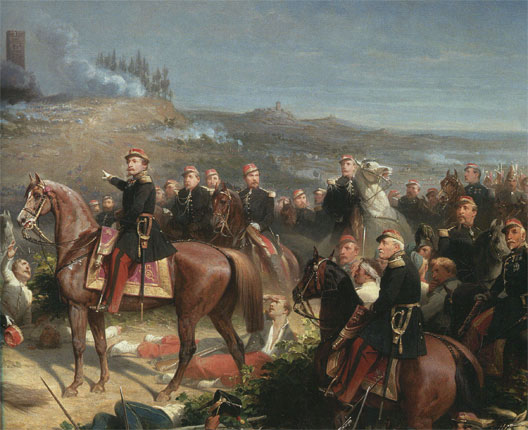
24 June 1859: Battle of Solferino (south of Lake Garda in Lombardy, Italy) “For fifteen hours on 24 June, 107,000 French and 44,000 Piedmontese troops fought a battle against 151,000 Austrians along a twelve mile front … After fierce fighting and heavy losses, the French finally stormed the key point, the Cypress Hill. By 2 p.m. a French regiment had captured the heights of Solferino … [Emperor Napoleon III of France] then turned his attention to the last Austrian stronghold at Cavriana … At 3 p.m. the Austrian centre broke, and [the Austrian emperor] Franz Joseph ordered a general retreat. As he rode off to Goito the hot weather … ended in a tremendous thunderstorm with heavy rain, which put a stop to all operations in the battlefield, as it was to dark for the troops to see anything. When the sky cleared an houtr later, the French found that the Austrians had gone. The losses on both sides were very heavy [French killed, wounded and missing: abt. 12.000, Piedmontese: 5500, Austrians: abt. 22.000] … The Austrians had withdrawn into the ‘Quadrilateral’ – the formidabel defensive works based on Mantua, Peschiera, Verona and Legnano … As the Piedmontese army began to invest Peschiera, the world waited for a third and even bloodier battle than Magenta and Solferino. Then. to the surprise of his generals, soldiers, allies and enemies, … [Napoleon III] offered the Austrians an armistice till 15 August, and proposed that he and Franz Joseph should meet to discuss peace terms. The Austrians agreed … There was much speculation at the time – and it has continued ever since – about the reason which induced Napoleon III to make peace with Austria after Solferino. He seems to have been influenced by four factors [: 1. he realized that the French would suffer even greater losses than at Solferino when they tried to storm the defences of the Quadrilateral, 2. he resented the attitude of the Piedmontese and he felt that [Prime Minister of the Kingdom of Piedmont-Sardinia ]Cavour’s plan was for the French to do most of the fighting and for Piedmont-Sardinia to reap most of the advantages, 3. he was worried that a prolongation of the war would eventually lead to a general European war (there was as yet no sign of Britain or Russia abandoning there neutrality, but there was a possibility that the German Diet would agree to sending an army corps to the Upper Rhine), 4. he was alarmed at the spread of revolution in Italy (Tuscany, Parma, Modena, Lucca, and the Papal province of the Romagna), and conscious of the difficulties in which this (especially of course a revolution in the Papal States) would involve him with the clergy in France. Also disturbing was the arrival of Hungarian revolutionary Kossuth in Genoa, who was obviously trying to incite a revolution in Hungary. A few months later Napoleon wrote to the Austrian Ambassador: “I was disgusted to have the Revolution following my heels, and Kossuth and [Hungarian general] Klapka as allies; I would be seen as the leader of all the scum of Europe”.] (J. Ridley, Napoleon III and Eugénie [London 1979], p. 450-454)