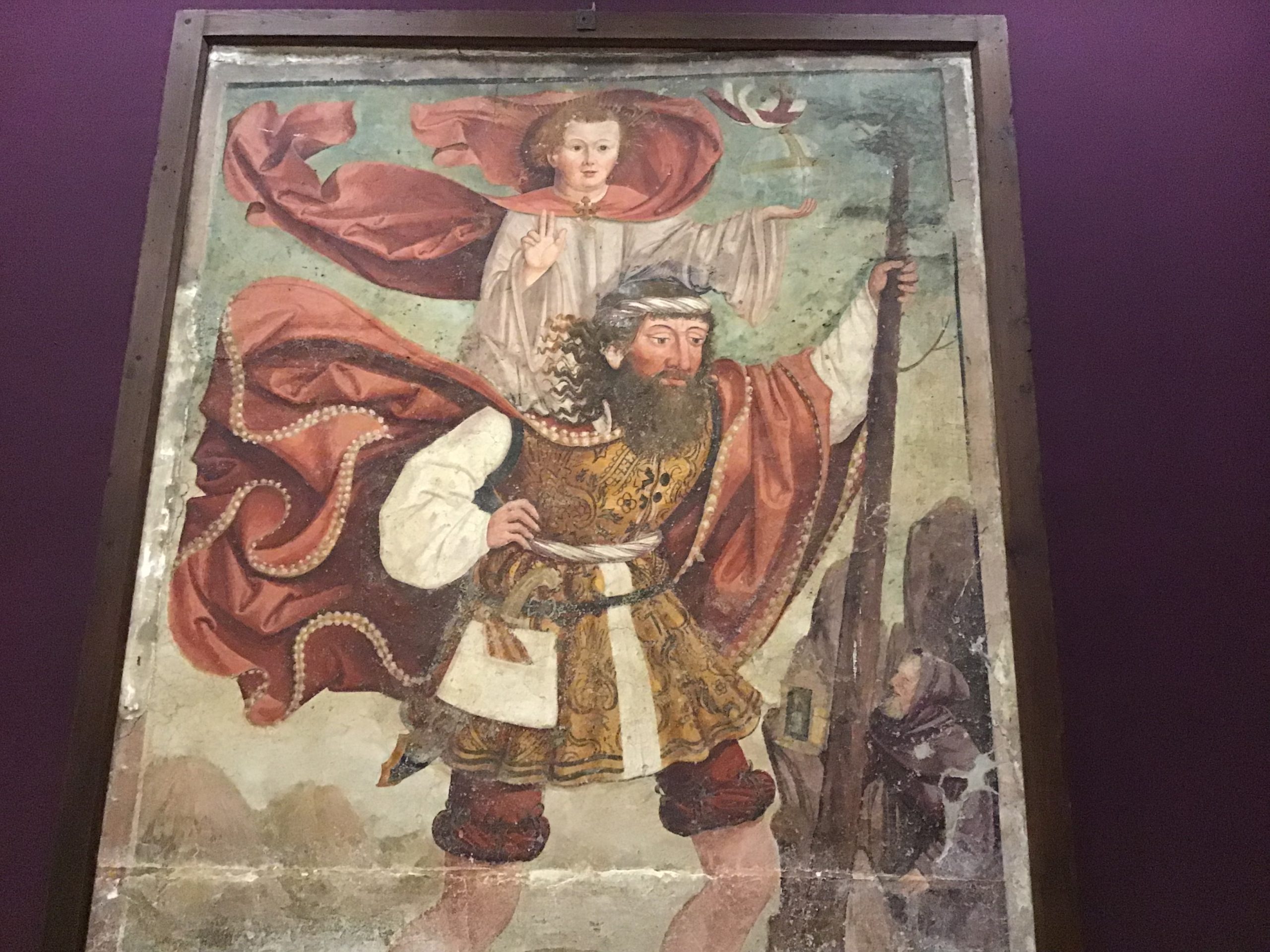
St. Christoffel, 1521? Saint Christopher (Greek: Ἅγιος Χριστόφορος, Ágios Christóforos) is venerated by several Christian denominations as a martyr killed in the reign of the 3rd-century Roman Emperor Decius (reigned 249–251) or alternatively under the Roman Emperor Maximinus II Dacian (reigned 308–313). There appears to be confusion due to the similarity in names “Decius” and “Dacian”.[3] However his veneration only appears late in Christian tradition, and did not become widespread in the Western Church until the Late Middle Ages, although churches and monasteries were named after him by the 7th century. Saint Christopher Bosch65.jpg St. Christopher Carrying the Christ Child, by Hieronymus Bosch (c. 1485) Martyr Born unknown Canaan (Western accounts) or Marmarica (Eastern accounts) Died c. 251 Asia Minor Venerated in Roman Catholicism Eastern Orthodoxy Lutheranism Oriental Orthodoxy Anglicanism Feast 25 July (Latin Church) 9 May (Eastern Churches)[1] 2 Parmouti (Coptic Church)[2] Attributes tree, branch, as a giant or ogre, carrying Jesus, spear, shield, as a dog-headed man Patronage bachelors, transportation (drivers, sailors, etc.), traveling (especially for long journeys), surfing, storms, Brunswick, Saint Christopher’s Island (Saint Kitts), Island Rab, Vilnius, epilepsy, gardeners, holy death, toothache It is disputed whether Christopher existed, and if so whether the name applied to a specific person or was a general title meaning “Christ-bearer” which was applied to several different real or legendary people. He may be the same figure as Saint Menas. His most famous legend, which is mainly known from the West and may draw from Ancient Greek mythology, tells that he carried a child, who was unknown to him, across a river before the child revealed himself as Christ. Therefore, he is the patron saint of travelers, and small images of him are often worn around the neck, on a bracelet, carried in a pocket, or placed in vehicles by Christians. (Wikipedia)