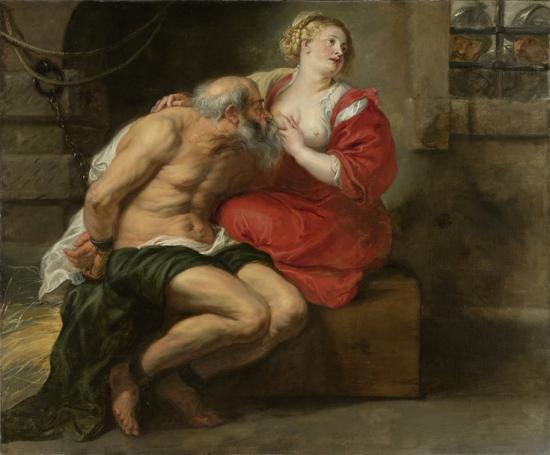
Rubens, Cimon en Pero (ca. 1630)
Roman Charity (Latin Caritas romana; Italian Carità Romana) is the exemplary story of a woman, Pero, who secretly breastfeeds her father, Cimon, after he is incarcerated and sentenced to death by starvation. She is found out by a jailer, but her act of selflessness impresses officials and wins her father’s release.[1]
The story is recorded in Nine Books of Memorable Acts and Sayings of the Ancient Romans (De Factis Dictisque Memorabilibus Libri IX)[2] by the ancient Roman historian Valerius Maximus, and was presented as a great act of pietas (i.e., filial piety) and Roman honour. A painting in the Temple of Pietas depicted the scene.[3] Among Romans, the theme had mythological echoes in Juno’s breastfeeding of the adult Hercules, an Etruscan myth.[4]
In the seventeenth and eighteenth centuries, many European artists depicted the scene.[5] Most outstandingly, Peter Paul Rubens painted several versions. Baroque artist Caravaggio also featured the deed (among others) in his work from 1606, The Seven Works of Mercy. Neoclassical depictions tended to be more subdued. [Wikipedia]
In de inventaris van de nalatenschap van Maria van Rommerswael, weduwe van Godschalck van der Hult, opgemaakt door notaris J. Hellu te Dordrecht op 2 april 1674 wordt vermeld: “een historie stuck van [Peter Paul Rubens] beeldens levens groote daer de dochter haer vader in de gevanckenisse laeft”. [ONA Dordrecht inv. 338]