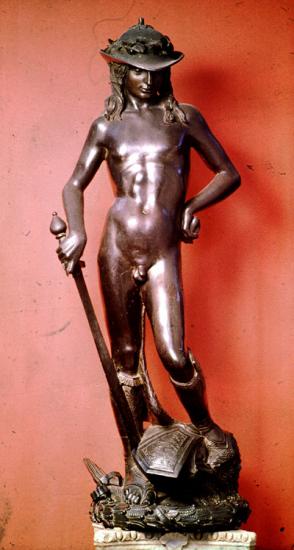
Donatello, David
Donatello’s bronze statue of David (circa 1440s) is famous as the first unsupported standing work of bronze cast during the Renaissance, and the first freestanding nude male sculpture made since antiquity. It depicts David with an enigmatic smile, posed with his foot on Goliath’s severed head just after defeating the giant. The youth is completely naked, apart from a laurel-topped hat and boots, and bears the sword of Goliath.
The creation of the work is undocumented. Most scholars assume the statue was commissioned by Cosimo de’ Medici, but the date of its creation is unknown and widely disputed; suggested dates vary from the 1420s to the 1460s (Donatello died in 1466), with the majority opinion recently falling in the 1440s, when the new Medici Palace designed by Michelozzo was under construction.[9] According to one theory, it was commissioned by the Medici family in the 1430s to be placed in the center of the courtyard of the old Medici Palace. Alternatively it may have been made for that position in the new Palazzo Medici, where it was placed later, which would place the commission in the mid-1440s or even later. The statue is only recorded there by 1469. The Medici family were exiled from Florence in 1494, and the statue was moved to the courtyard of the Palazzo della Signoria (the marble David was already in the palazzo). It was moved to the Palazzo Pitti in the 17th century, to the Uffizi in 1777, and then finally, in 1865, to the Museo Nazionale del Bargello, where it remains today.[10][11][12][13]
According to Vasari, the statue stood on a column designed by Desiderio da Settignano in the middle of the courtyard of the Palazzo Medici; an inscription seems to have explained the statue’s significance as a political monument.[14] A quattrocento manuscript containing the text of the inscription is probably an earlier reference to the statue; unfortunately the manuscript is not dated.[15] Although a political meaning for the statue is widely accepted, but what that meaning is has been a matter of considerable debate among scholars.[16]
The iconography of the bronze David follows that of the marble David: a young hero stands with sword in hand, the severed head of his enemy at his feet. Visually, however, this statue is startlingly different. David is both physically delicate and remarkably effeminate. The head has been said to have been inspired by classical sculptures of Antinous, a favorite of Hadrian renowned for his beauty. The statue’s physique, contrasted with the large sword in hand, shows that David has overcome Goliath not by physical prowess, but through God. The boy’s nakedness further implies the idea of the presence of God, contrasting the youth with the heavily-armored giant. David is presented uncircumcised, which is customary for male nudes in Italian Renaissance art.[17]
There are no indications of contemporary responses to the David. However, the fact that the statue was placed in the town hall of Florence in the 1490s indicates that it was not viewed as controversial. In the early 16th century, the Herald of the Signoria mentioned the sculpture in a way that suggested there was something unsettling about it: “The David in the courtyard is not a perfect figure because its right leg is tasteless.”[18] By mid-century Vasari was describing the statue as so naturalistic that it must have been made from life. However, among 20th- and 21st-century art historians there has been considerable controversy about how to interpret it.
Goliath’s beard curls around David’s sandaled foot, as if the young hero is running his toes through his dead opponent’s hair. Goliath is wearing a winged helmet. David’s right foot stands firmly on the short right wing, while the left wing, considerably longer, works its way up his right leg to his groin.
The figure has been interpreted in a variety of ways. One has been to suggest that Donatello was homosexual and that he was expressing that sexual attitude through this statue.[19][20] A second is to suggest that the work refers to homosocial values in Florentine society without expressing Donatello’s personal tendencies.[21][22] However, during the Renaissance sodomy was illegal, and over 14,000 people had been tried in Florence for this crime.[23] So this homosexual implication would have been dangerous. A third interpretation is that David represents Donatello’s effort to create a unique version of the male nude, to exercise artistic license rather than copy the classical models that had thus far been the sources for the depiction of the male nude in Renaissance art.
The traditional identification of the figure was first questioned in 1939 by Jeno Lanyi, with an interpretation leaning toward ancient mythology, the hero’s helmet especially suggesting Hermes. A number of scholars over the last 70 years have followed Lanyi, sometimes referring to the statue as David-Mercury.[25] If the figure were indeed meant to represent Mercury, it may be supposed that he stands atop the head of the vanquished giant Argus Panoptes. However, this identification is certainly mistaken; all quattrocento references to the statue identify it as David.[26]
The statue underwent restoration from June 2007 to November 2008. This was the first time the statue had ever been restored, but concerns about layers of “mineralized waxings” on the surface of the bronze led to the 18-month intervention. The statue was scraped with scalpels (on the non-gilded areas) and lasered (on the gilded areas) to remove surface build-up.[27] (Wikipedia)